White Gold
White Gold interweaves Amina’s family history with the broader story of Egypt’s cotton industry. What began as a search for roots, became an exploration of cotton as a colonial legacy, yet deeply interwoven with Egyptian identity. As the fourth generation of a family involved in this trade, Amina draws on personal and found archives, oral histories, and her own photographs to counter narratives shaped by colonial and state power. The work aims to revive forgotten voices and reconnects communities to their own histories.
“What began as a search for my roots, later on unfolded into a complete investigation into how cotton is a colonial relic; imposed and was not native to Egypt, yet it became absorbed into our cultural identity while its origins were forgotten.
The seeds of my story began with my own family in my hometown El Mehalla Al Kobra, home to me and the Egyptian cotton. Known as the citadel of industry, it was one of the most popular cities in Egypt for the harvesting and spinning of white cotton. My great grandfather was a merchant of silk and wool, one of the first in El Mehalla to lead the initial stage of the popular manufacturing textile trade at the time. In 1969, my grandfather established his textile factory and my father continued the journey in the 80’s. Now, as a fourth generation of a family involved in this industry for almost a century I, too, return to it, through photography, archives, and memory. I see myself mirrored in the cotton: uprooted and trying to piece together my sense of belonging.
Generation after generation, stories are passed down contradicting the historical narrative. For almost five years, White Gold has evolved beyond myself. Traveling round Egypt to places that once cultivated, manufactured, wove, or traded in cotton. I connect the route from Mehalla El Kubra to Alexandria’s Minet el Basal industrial heritage site, once-thriving industrial hub, a global compass for cotton trade and export.
I am challenging the dominant narrative of Egypt’s cotton history that is often framed through colonial, economic, or governmental perspectives, leaving behind personal narratives of those who lived and worked within it. My project actively counters this erasure by presenting first-person narratives, personal and found archives, documents, objects, oral histories, alongside my photographs, reviving lost stories, and trying to reconnect communities to their own histories. All to tell a very personal story yet it's about a nation state.
The story of cotton is a story of a human seed, a reflection of Egypt and myself. I try, through this work, to reconnect and recollect what is left of our withering seeds of cotton. Exploring what used to be one the most important industries embedded in our collective fabrics. Beneath these layers, unfolds the lineage of Egypt, from past to present. What could have been, what have we lost and what could still be?” – Amina Kadous
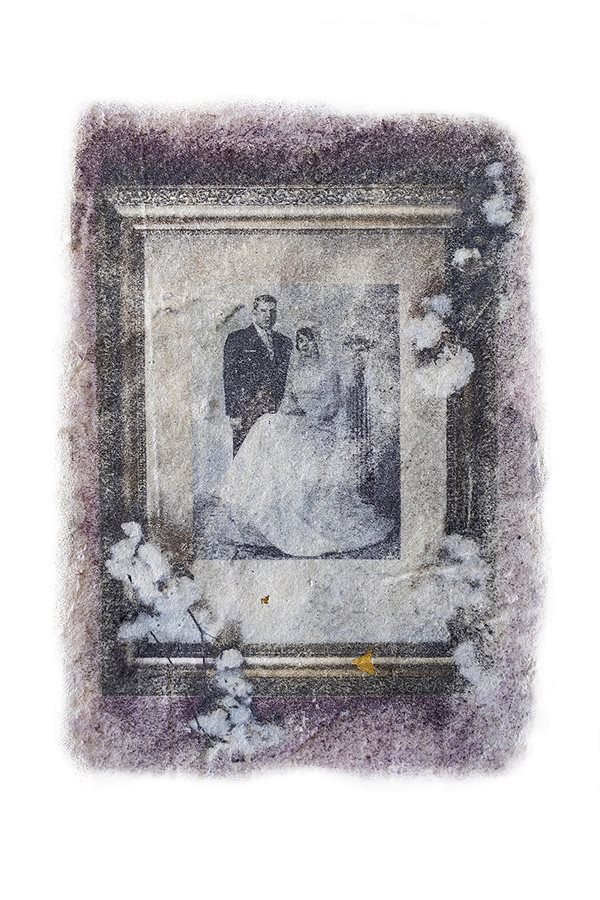
A wedding portrait of the photographer’s grandparents, taken in 1961, and transferred onto handmade cotton paper.
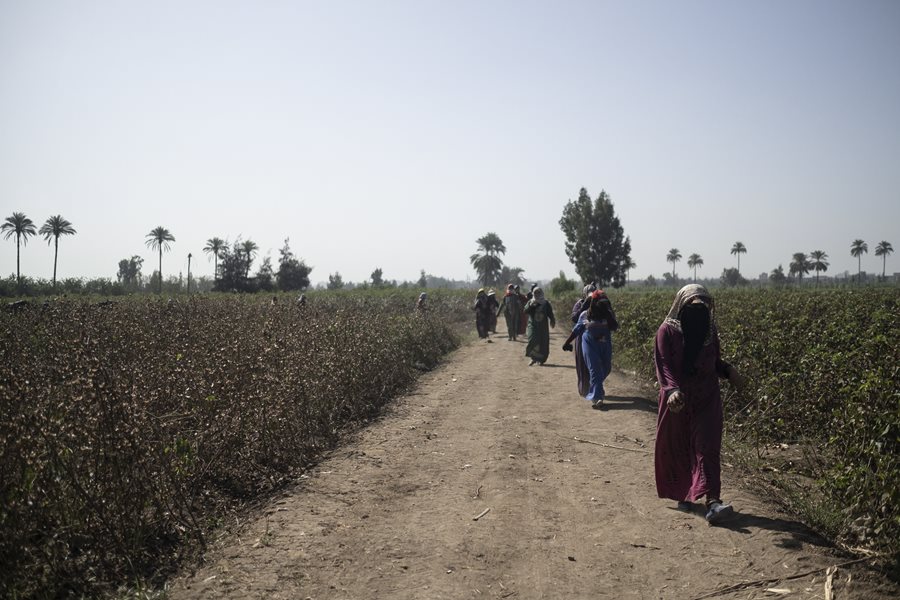
Women cotton pickers walk through the harvested fields under the midday sun after completing their first shift. El Mehalla El Kubra, Egypt, 29 September 2020.
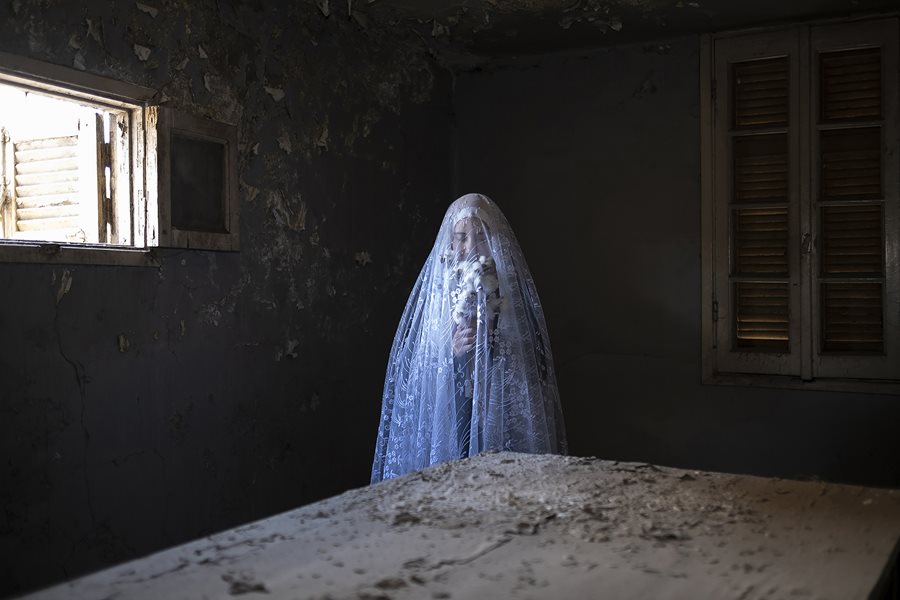
The photographer holds a bouquet of cotton flowers, her face covered by a veil, in her grandmother’s kitchen at the family’s old home. She says, “Uprooted and pulled from the ground, I see myself in the cotton’s journey — both of us, plant and human, lost and fragmented, trying to weave our common threads. We endure change, inside and out, always trying to adapt to the world around us.” El Mehalla El Kubra, Egypt, 21 January 2021.
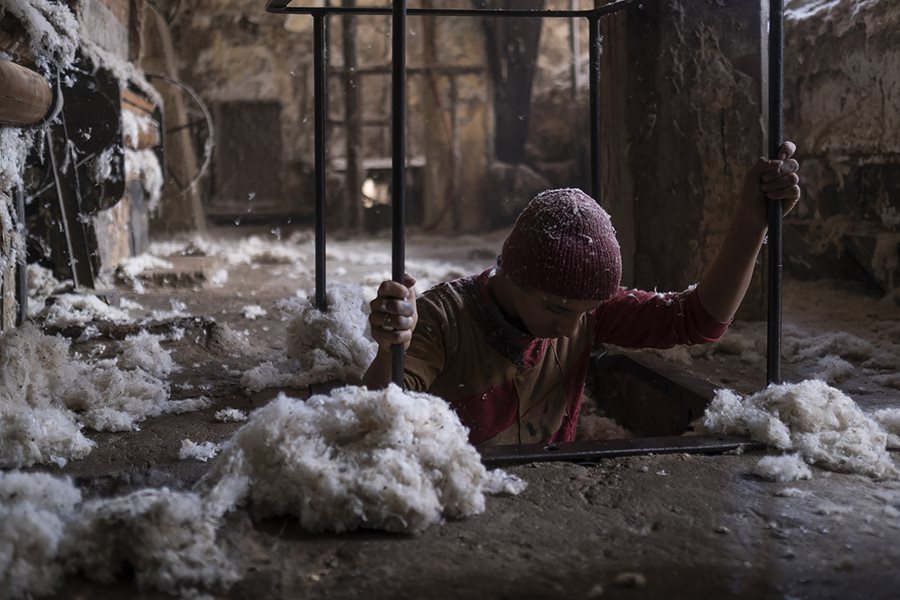
A young boy stands inside one of the main rooms of the Misr Ginning Factory as he feeds “the Ghost Machine” with cotton. Named for the way they often devour workers’ arms without warning, these fearful machines are still in use 100 years after their installation. The Egyptian government has announced plans to replace and modernize these facilities. El Mehalla El Kubra, Egypt, 10 February 2021
The former general director of the Misr Spinning and Weaving Company stands inside one of four power plant stations located on the company’s premises. These stations power the machines and supply electricity to the factories. Until a certain time, they also provided power to the entire area of El Mehalla. El Mehalla El Kubra, Egypt, 13 January 2021