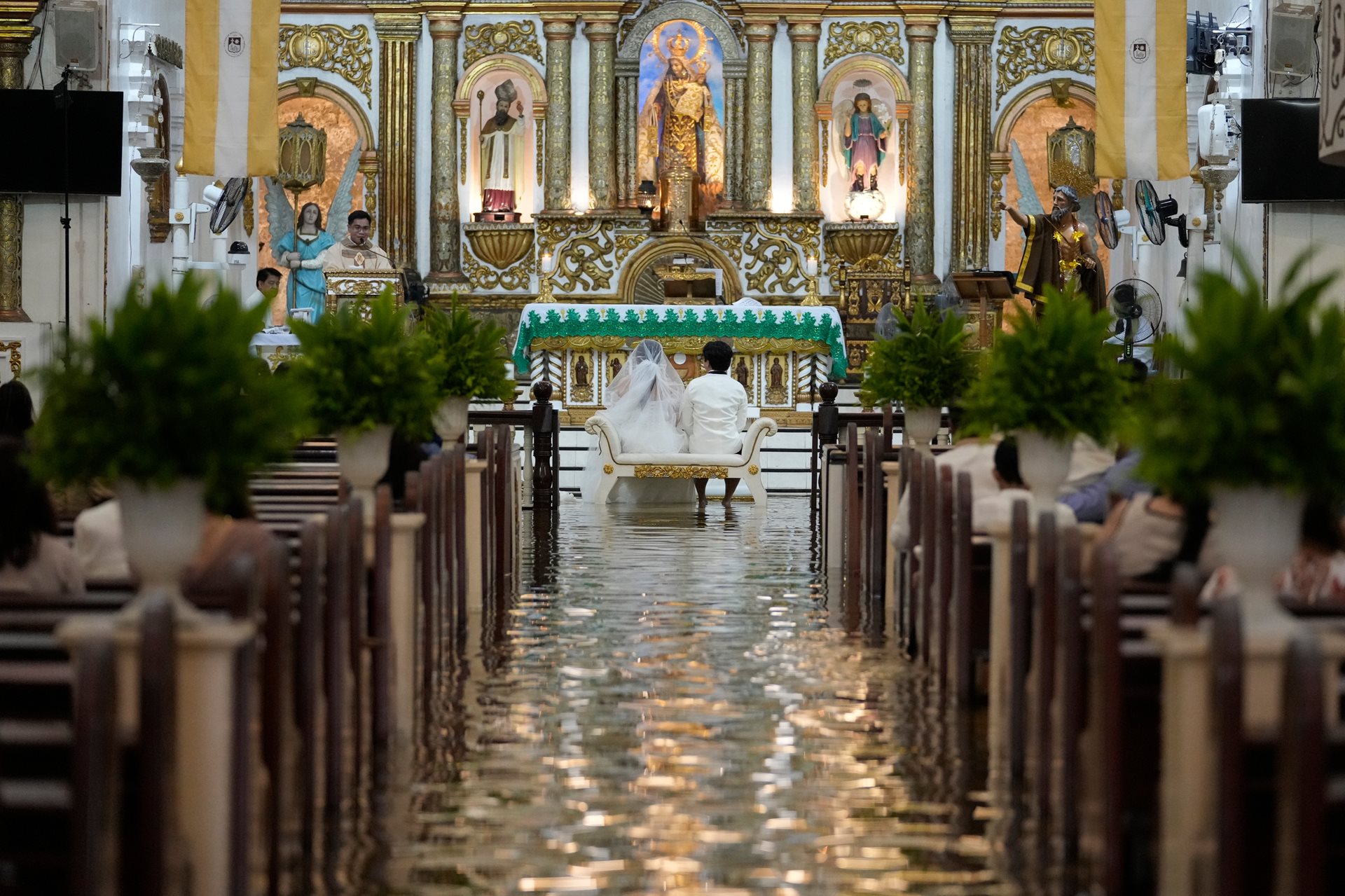


Jade Rick Verdillo and Jamaica Aguilar sit before the altar in Barasoain Church. After a ten-year courtship, the couple embraced the flood as one of the challenges to navigate in a relationship. Malolos, Bulacan province, Philippines
When Typhoon Wipha hit the Philippines in July 2025, it submerged the historic Barasoain Church in Malolos, Bulacan province under several feet of water. Jade Rick Verdillo and Jamaica Aguilar faced a difficult decision: should they postpone their wedding ceremony, or proceed through knee-deep floodwaters? Despite warnings from wedding planners that the weather would only worsen, they decided to push through. The photos from that day would go viral, becoming a testament to not only love’s resilience against all obstacles, but also a mounting environmental crisis in the region.
Located on a low-lying delta, Bulacan province is vulnerable to flooding due to systemic infrastructure failures and global climate change. While the Philippines has always been prone to tropical cyclones, the intensity of rainfall and the frequency of severe flooding have significantly increased since 2012. More frequent and violent weather events in the area are compounded by aging drainage systems, controversial dredging projects, and the overextraction of groundwater, which causes the land to subside -- sink or cave in against water -- even as sea levels rise. In this region, nearly 75% of the population is now exposed to high-level flooding hazards, turning what were "once-in-a-generation" storms into seasonal realities.
Beyond the wedding ceremony, the floods of 2025 became a catalyst for widespread political unrest. A groundswell of public anger triggered protests over "ghost" infrastructure projects in which funds allocated to climate adaptation measures disappeared due to corruption. Dubbed the "Trillion Peso March," the mass demonstrations were based on reports that 1.089 trillion Philippine pesos (17.6 billion US dollars) had been skimmed from these funds. This project captures not only a personal milestone for a happy couple, but also the larger context of political and environmental turmoil that defined the region.
In a time when independent photojournalism is increasingly vulnerable, donations from people like you give us the ability to work globally with photographers who believe in the power of photography to inspire change. Support World Press Photo today.