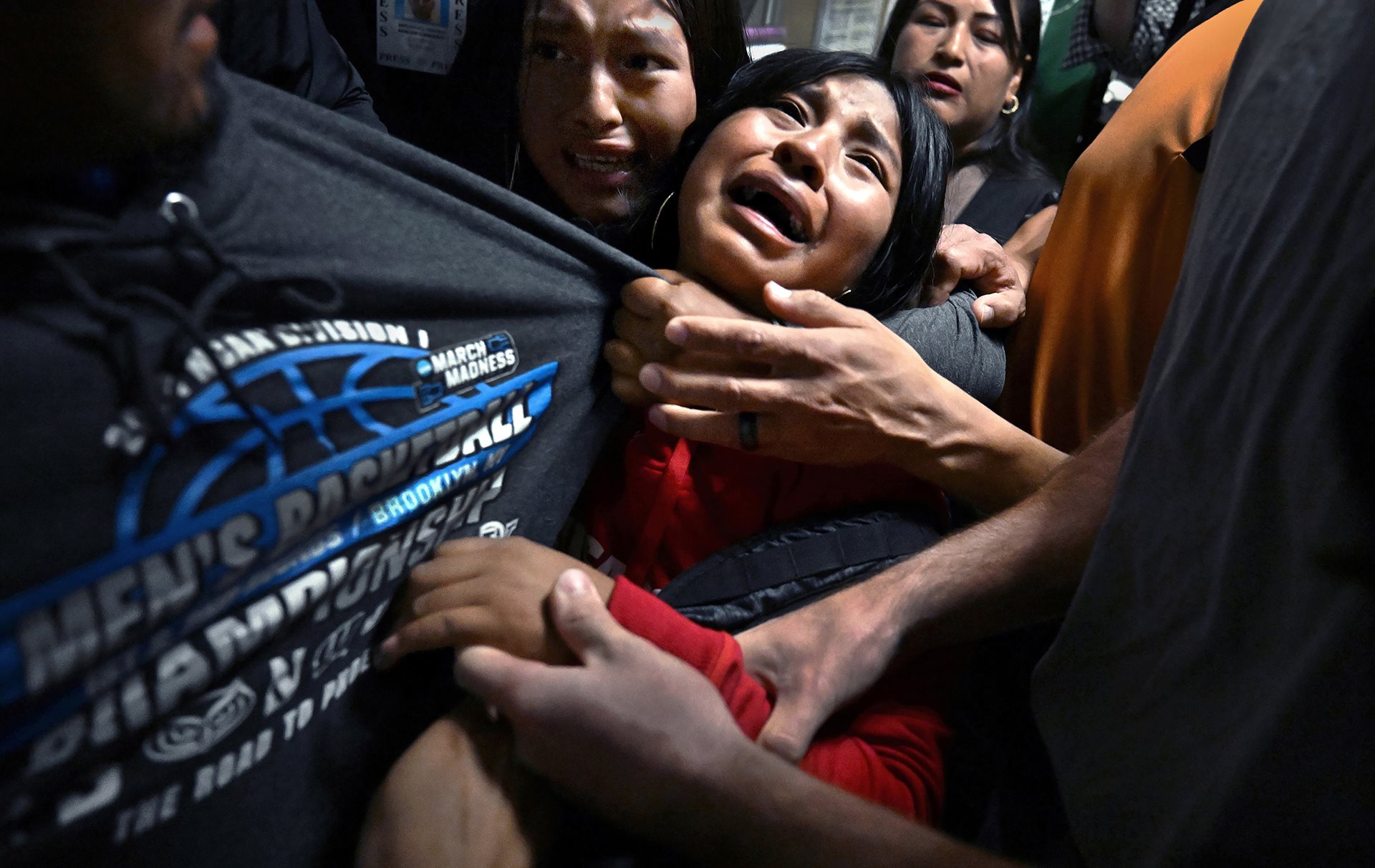


Luis’s distraught daughters cling to their father as Immigration and Customs Enforcement (ICE) agents detain him after an immigration hearing in New York City, New York, United States.
“Please understand we are coming here for a better opportunity, not just for ourselves, but for our children,” said Cocha, after her husband, Luis, was detained by ICE agents following an immigration court hearing at the Jacob K. Javits Federal Building. Luis, an Ecuadorian migrant living in the Bronx, served as his household’s sole provider. According to his family, he has no criminal record. Cocha and their three children – ages seven, 13, and 15 – were left inconsolable, facing immediate financial hardship and profound emotional trauma.
In 2025, a dramatic escalation in US immigration policy transformed the Jacob K. Javits Federal Building in Lower Manhattan from a courthouse into a focal point for mass deportation. Following a January 2025 executive order, US Immigration and Customs Enforcement (ICE) reversed “sensitive locations” protections, authorizing arrests at schools, hospitals, and courthouses. This shift turned the city’s immigration courts into sites where masked agents in balaclavas wait outside hearings to identify and detain undocumented migrants, regardless of whether a judge has granted a stay or legal continuance.
This strategy, fueled by an unprecedented $75 billion of federal funding for ICE, has resulted in a 2,450% increase in the detention of individuals with no prior criminal record. The humanitarian cost of such an expansion is visible on the 10th floor of the Jacob K. Javits Building. While officially classified as a “processing center” to bypass Congressional inspection, a 2025 policy waiver allowed the floor to function as a long-term detention site. A successful class-action lawsuit led to a preliminary injunction in August 2025, compelling ICE to address “deplorable” conditions, including forcing detainees to sleep on concrete floors without access to soap, toothbrushes, or medical care.
Beyond the legal battles, Carol Guzy’s photos capture the deep trauma of “interior separations.” Unlike border enforcement of previous years, these arrests occur in the heart of the city, separating families in public spaces, often in front of young children. This image, and the story it is a part of, serves as an important record of the reality for many people in the United States, where fear of separation and deportation pervades in the places where immigrant families once sought protection and justice.