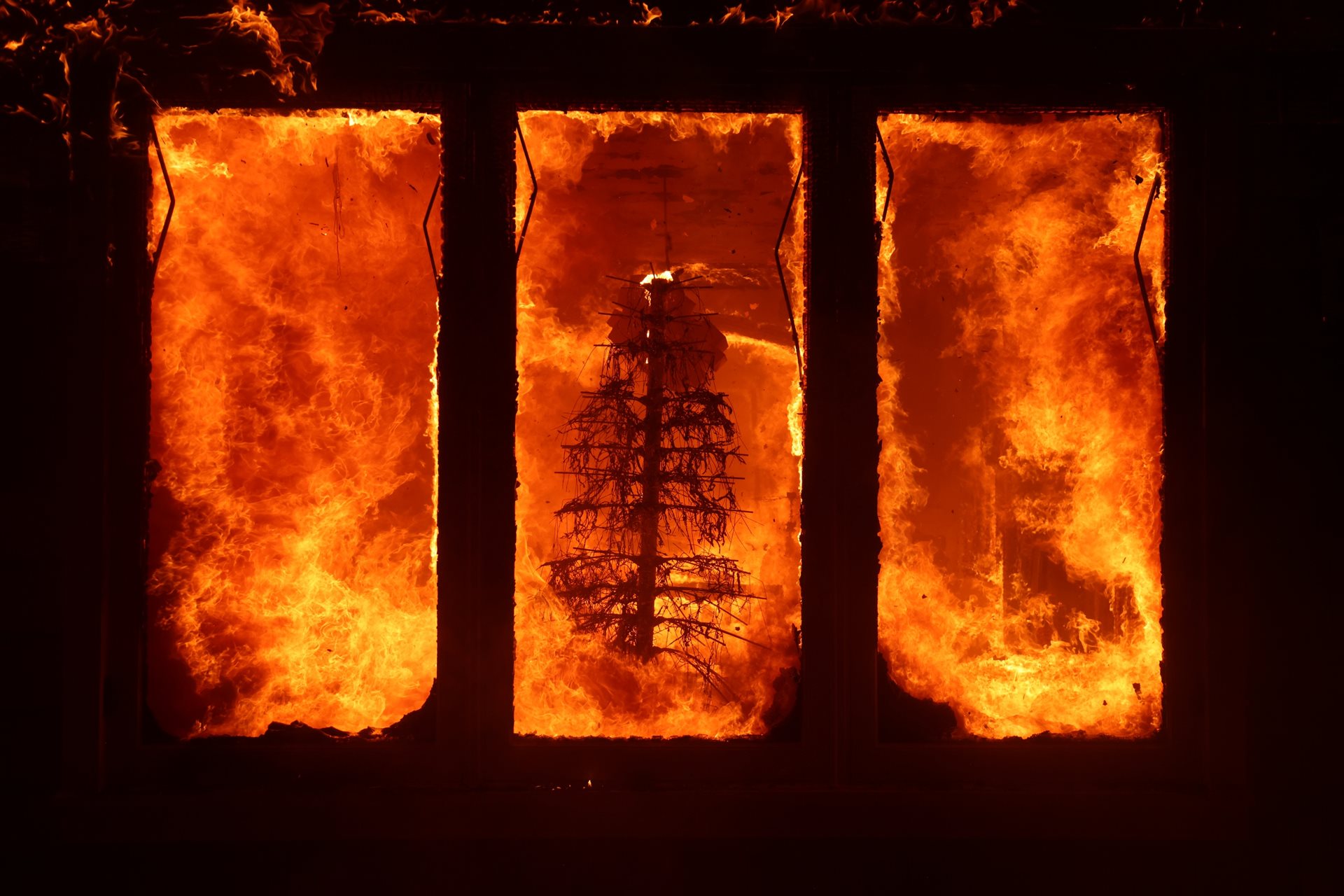


The Palisades Fire consumes a Christmas tree inside a residence. Santa Ana winds may have reignited a “zombie fire”; embers from a New Year’s Day brushfire that had smoldered underground for days before surfacing during a period of record-low humidity. Los Angeles, California, United States.
For more than three weeks in 2025, a volatile mix of extreme weather conditions transformed the Southern California landscape into an expanding patchwork of wildfires. After a period of record-dry heat followed an unusually wet winter, a buildup of flammable vegetation primed the region for disaster. When hurricane-force Santa Ana winds peaked at 100 mph (160 kph), 14 distinct wildfires erupted across the Los Angeles metropolitan area and San Diego County. These blazes, moving with unprecedented speed through parched canyons, eventually scorched over 57,500 acres of land.
The two largest wildfires, the Eaton Fire in Altadena and the Palisades Fire in Pacific Palisades, now rank as the second and third most destructive in California’s history. Together, they destroyed more than 18,000 homes and businesses, forcing the emergency displacement of 200,000 residents. While official tallies recorded 31 direct fatalities, a study published in the Journal of the American Medical Association estimated approximately 440 excess deaths linked to toxic smoke inhalation and the systemic disruption of medical care during the crisis.
Beyond the physical destruction, the fires revealed the region’s stark socio-economic disparities. Property damages are estimated between $28 billion and $53.8 billion, yet the recovery has been defined by a “wealth divide.” While affluent homeowners in the Palisades often possess the insurance and private resources to rebuild, thousands of displaced residents and nearly 1,900 affected businesses face a five-year projected loss of up to $9.7 billion in economic output. Despite this recurring threat, historical data suggests that the majority of structures in high-risk zones are rebuilt in the same locations, illustrating a profound lack of adaptation to the intensifying climate reality of the United States.
Behind every powerful image is a story someone chose to tell. And often, a risk someone chose to take. Support World Press Photo by making a donation to ensure these important stories are seen across the globe.