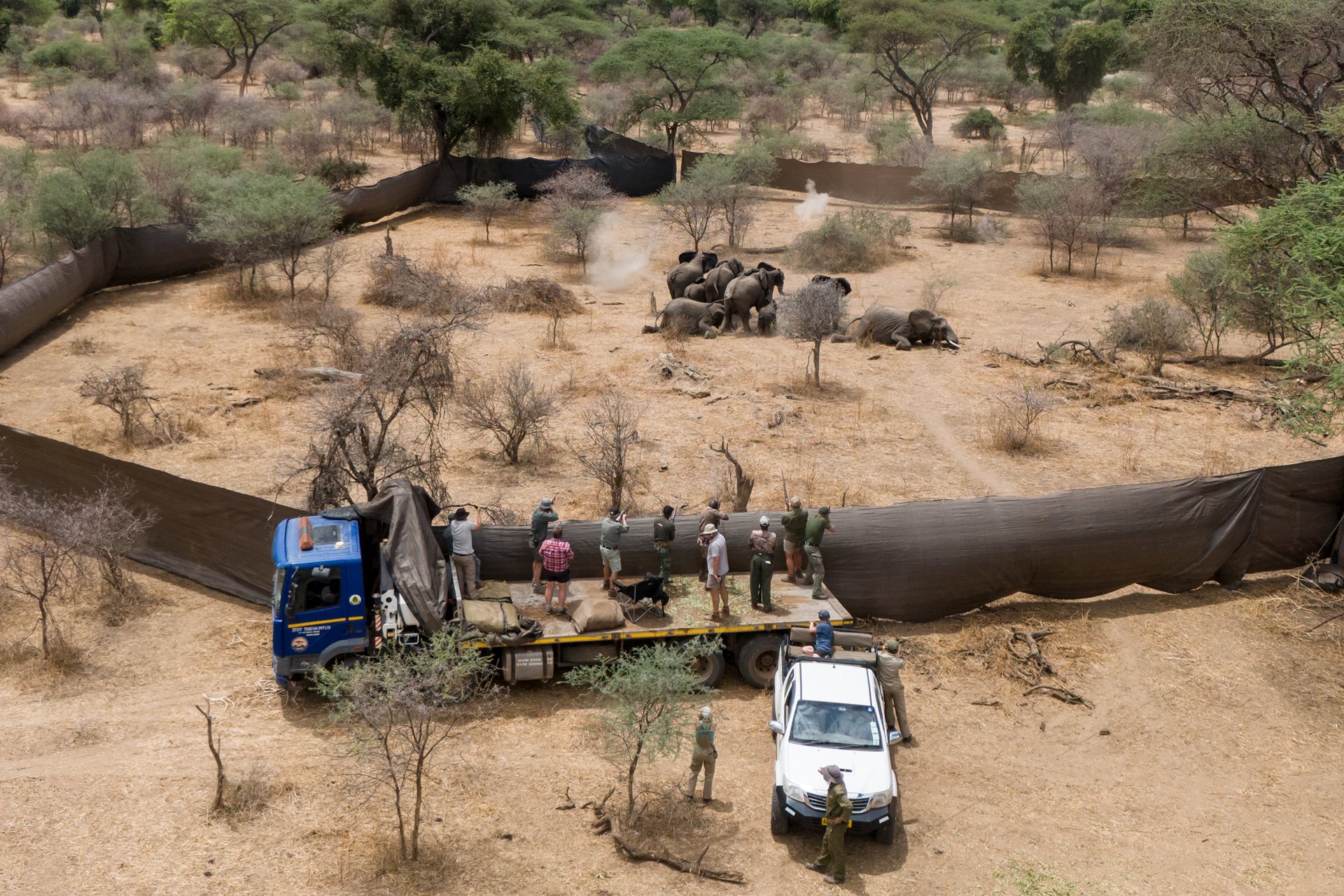


Professional hunters shoot a family of elephants identified for culling at Sango Wildlife Conservancy in Savé Valley Conservancy, Zimbabwe.
In 2025, the government of Zimbabwe authorized the culling (killing for the purpose of population control) of 50 elephants in the Savé Valley Conservancy. This decision followed a 2024 cull of 200, the country’s first since 1988. Meat from the culled elephants was distributed to local communities, a practice the government says helps improve food security. The ivory from the killed animals was handed over to the parks authority.
Zimbabwe is home to an estimated 100,000 elephants, the second largest population in the world. According to the Zimbabwe Parks and Wildlife Management Authority, about 2,550 elephants inhabit land in the Savé Valley Conservancy that can only sustainably support 800. Officials are also concerned about worsening human-wildlife conflict, with dozens of deaths reported in recent years. Drought has exacerbated the problem, driving elephants into populated areas in search of food and water.
Wildlife organizations across Africa and internationally condemn culling. They dispute claims of overpopulation, citing studies that show elephant populations in southern Africa have remained largely unchanged since 2014. These conservation groups argue that culling fractures elephant social structures and traumatizes surviving animals, which could increase aggression toward humans rather than reduce human-wildlife conflict. As an approach to food security, they contend that culling is unsustainable and poses public health risks through disease transmission from bushmeat consumption, while potentially fueling poaching and illegal ivory trade.
The conservancy attempted to control the population by relocating 200 elephants to other reserves over the past five years, though lack of funding has hampered further relocation efforts.
In a time when independent photojournalism is increasingly vulnerable, donations from people like you give us the ability to work globally with photographers who believe in the power of photography to inspire change. Support World Press Photo today.