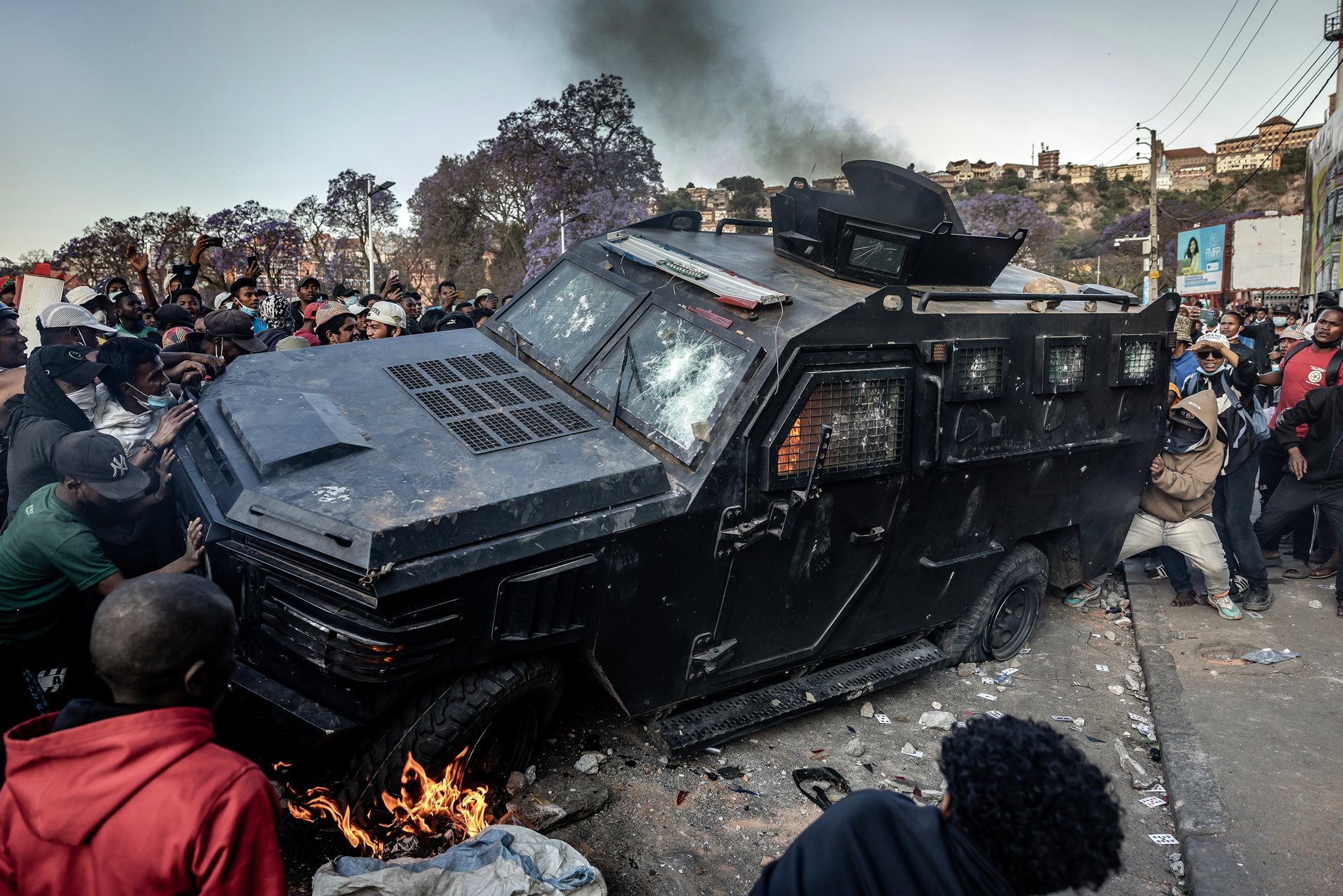


Protesters vandalize a Gendarmerie armoured vehicle as members of the CAPSAT military unit take control of the area around Lake Anosy, Antananarivo, Madagascar during clashes between demonstrators and security forces.
In September 2025, students began protesting across Madagascar over failing public services, corruption, and economic hardship. The economy had suffered years of climate-related shocks – including droughts, floods, and cyclones – with little government response. Chronic power and water cuts increased tensions.
President Andry Rajoelina, who had been re-elected in December 2023 amid accusations of unfair election conditions and the lowest-ever voter turnout (46.35%), responded on 26 September by firing the Minister of Energy. Three days later, when he dissolved his government but refused to resign, demonstrations intensified. On 11 October, the CAPSAT military unit defected to join the protesters, the same force that had installed Rajoelina in a 2009 coup. Days later, with Rajoelina in hiding, the military seized power. Colonel Michael Randrianirina, head of CAPSAT, was sworn in as transitional president on 17 October, promising elections within two years.
In a pattern seen across Gen Z uprisings in Bangladesh, Nepal, and Bulgaria, Madagascar's youth forced regime change but were excluded from shaping the political transition that followed. Protest organizers described Randrianirina’s appointment as “non-transparent” and “without consultation,” saying it would not address the structural changes the protests had demanded. The African Union suspended Madagascar and the UN condemned the unconstitutional change of government. During the protests, at least 22 people were killed and more than 100 injured. Further injuries were reported, though official figures were not updated.
At no time is the need for accurate information more essential, while at the same time, more difficult to produce. That’s why we all need to support a free press. Make a donation to World Press Photo today to strengthen photojournalism.