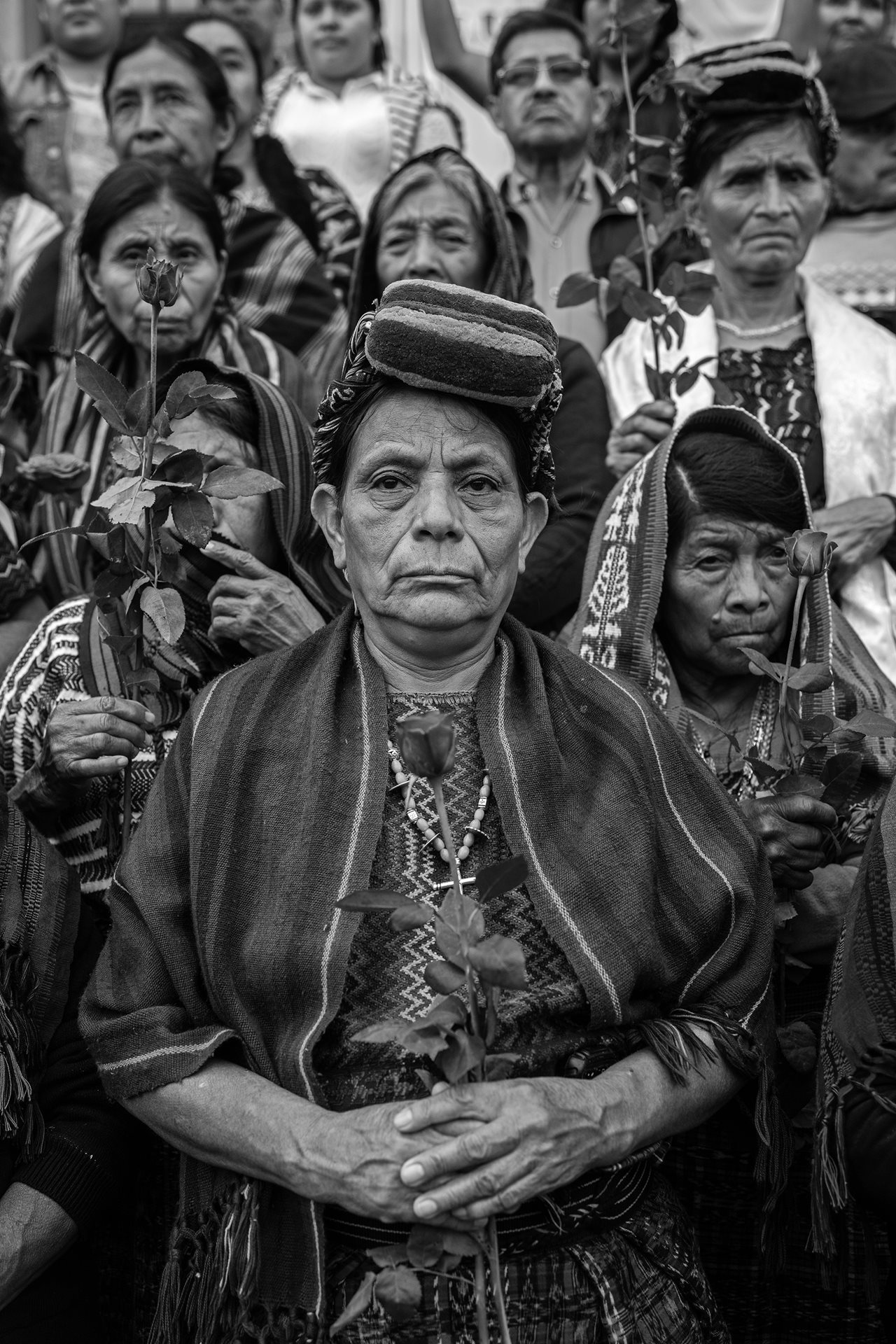


Doña Paulina Ixpatá Alvarado, a plaintiff who was held captive and assaulted for 25 days in 1983, stands with fellow Achi women outside a Guatemala City court in Guatemala. That afternoon, three former civil defense patrollers were sentenced to 40 years in prison for rape and crimes against humanity.
For four decades, a group of Indigenous Maya Achi women in Rabinal lived in the same communities as the men who had raped them. During Guatemala’s 36-year civil war (1960 to1996), a conflict triggered by the 1954 US backed overthrow of President Jacobo Árbenz, the military and state-sponsored Civil Defense Patrols (PAC) utilized rape as a deliberate weapon of war. This violence was part of a broader campaign of genocide that resulted in the deaths or disappearances of over 200,000 people, 83% of whom were Indigenous Maya.
In 2011, 36 Achi women broke their silence by forming a support group to share their stories of sexual assault during the war. In subsequent years they began organizing to bring a legal case against their aggressors, and in 2018 filed a formal complaint with the Public Prosecutor’s Office. Supported by the Bufete Jurídico y Popular of Rabinal, the women navigated a judicial system that initially dismissed their charges; in 2019, a judge was recused for failing to accept their testimonies as evidence. Despite these obstacles, and the suspension of US foreign aid in early 2025 which eliminated funding for the legal team supporting the case, the group persisted. Their 14-year legal battle achieved a landmark victory in 2022 when five former patrollers were sentenced to 30 years in prison for crimes against humanity.
On 30 May 2025, the court sentenced three additional former civil defense patrollers to 40 years in prison each. The court’s decision represents a definitive rejection of wartime impunity. For the survivors, the verdict replaced a legacy of state-sponsored terror with a historic recognition of their rights, ensuring that the crimes committed against them and their culture would no longer be met with silence.
In a time when independent photojournalism is increasingly vulnerable, donations from people like you give us the ability to work globally with photographers who believe in the power of photography to inspire change. Support World Press Photo today.