Yatou Sallah: I’m excited to have this conversation on the eve of the opening of the What Have We Done? exhibitions in Johannesburg and Groningen. Could you briefly introduce yourself and tell us what Drik Picture Library is?
Shahidul Alam: I'm Shahidul Alam. I'm a photographer and writer based in Bangladesh. Drik Picture Library was set up in 1989 largely in response to what we felt was the power wielded by the control of the narrative that has given Western media, and in particular Western photographers, the ability to determine perceptions of what we call the Majority World. We didn't use the term when we started, but we began challenging the lexicon itself and the fact that we were, in a sense, defined in terms of what we were not, rather than what we were.
Until quite recently, it was white Western photographers who were the ones who travelled the globe, who went to “exotic” locations, who revealed to us their visual discoveries. It was not a challenged position, partially because the gatekeepers were also largely from wealthy white nations in positions of power. Drik was largely set up as a mechanism for challenging this hegemony—creating a platform for local storytellers who were closer to their communities, more aware of their realities, and probably more able to provide a more nuanced rendering of the lives of their communities.
YS: How has Drik’s role in linking photography with politics evolved over the years, and how do you see its position today, especially in the context of Bangladesh’s current period of transition?
SA: Drik was set up as an organization intent on dealing with social inequality. This is, of course, a very political position, not just globally, but within our own country itself. Every year, on our walls, we show pictures that the government denies. But each year, their denials are rebutted by these images on the walls.
We’ve taken some conscious decisions over time, one being that we’ve felt that, as a media organization, we needed to be independent. Very soon, we started seeing that if we were to fight a battle—and that's largely what it was, a battle—we needed warriors. We then set up the school of photography, Pathshala, which has now become an independent institution. Something I'm very proud of is the fact that when I started Pathshala, I was the only local teacher, and I would hustle my friends from across the globe to come and teach. Today, I think 24 of our 26 teachers are former students. So that's a very organic strength that we now have. Next, we set up a festival of photography in 2000, Chobi Mela. We now collectively work across those three areas of intervention: media, education, and culture. And through the three strands of intervention, we try to create pressure upon the political space so the powerful elite cannot get away with indiscretions.
We have always worked with communities, and our commitment to human rights is important. Over the last 15 years, where there's been so much repression, the Drik building was sort of an oasis within this very repressive space. This was a place where you could say things no one else would be prepared to allow you to say, a place to do things and take a position. Of course, we paid the price on several occasions, but Drik has been this place of defiance.
And that has led to the recent moment and the fact that we played such an important role, becoming the epicenter of the movement. And even after the movement, this was a place where the students gathered. This was the place where they had their meetings with civil society, with the UN. It was actually where they had their unofficial launch of their political party. So we're really very well grounded in those realities.
YS: The 70th anniversary exhibition reflects on the legacy of World Press Photo—how the institution has shaped visual culture. In doing so, de Middel lays bare the recurring visual themes running through the archive. Why do you think bringing awareness to and engaging with these themes is especially important now?
SA: Firstly, I think it's very important that there is this critical self-reflection—it's not something that every organization does. World Press Photo, having started in 1955, has a long tradition and history. But that legacy can also be overbearing and perhaps limit one's ability to be self-critical. So I'm very happy it's happening.
But the archive itself is very politically charged and can be problematic. The sheer mechanics of storage result in archives being more about exclusion rather than inclusion. As such, archivists become permanent gatekeepers, and what is excluded may potentially be lost from history.
Of course, archives are vitally important in terms of preservation, in terms of ensuring history and culture, particularly in fragile economies that do not have the means. But in that process, there is potentially the risk of a rewriting of history, which can be damaging. So what determines the parameters that govern archiving decisions becomes very important. And that is what I think Cristina has tried to do here—look at what these parameters might have been, what decisions were made, whether there were built-in biases that might be addressed, and whether those tropes have reinforced the stereotypes or not.
The archive is a visual history of the world. But through this process, what we're also doing is questioning the history of the world. It is not one particular history, but a history that is defined by who, at any particular point in time, made those critical decisions. Recognizing the power dynamics within this space is extremely important. At Drik, for instance, one of the things we did very early on was question our own position within the media space. We recognized that someone like me, a male, middle-class photographer, was also part of that power structure. And that a woman in a slum who didn’t have a door to shut on my face probably didn’t feel that much of a difference between me taking pictures or a white Western photographer taking pictures.
YS: Thinking about archives as a way through which visual history is shaped, what do you see as the main challenges in ensuring access and ethical representation? I'm particularly interested in how this plays out through Drik’s work, as well as your view on global platforms like World Press Photo, where barriers to entry determine which images get remembered.
SA: Drik is a small organization, and while we do have an archive of our own, we have not yet been able to make it as accessible to the general public as we would like. We built our archives because we felt it was needed, and in the absence of those archives, a lot of material would be lost. But some of the things we are now doing, for instance, are linking the archive with the wider spectrum of work that we do. We are working with universities to redesign their curricula. We’re training teachers. We've set up a media library, which we are trying to make as accessible as we can.
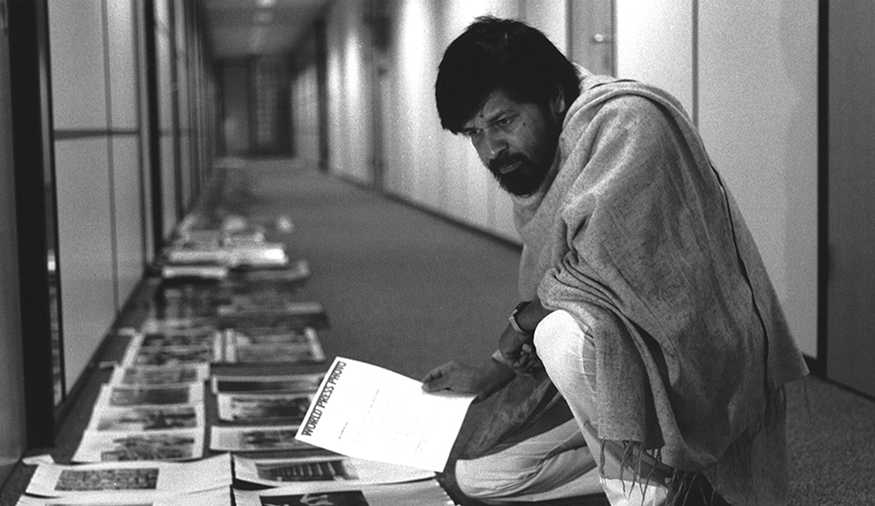
But there are issues. I think it was 1994 when I was on the World Press Photo Contest jury for the first time. At that time, the contest used all physical prints. Now, high-quality physical prints are very, very difficult and expensive to make. Those who worked with slides did not have the means of duplicating them, so you had to send off your originals to be considered for a contest.
But we also did other things to make it a more level playing field. Drik introduced email to Bangladesh in the early 1990’s and that eventually led to the internet coming to Bangladesh. The presence of the internet—though it’s not an entirely level playing field yet—has made it possible for many photographers to participate and compete who would not have been able to do so in the past.
I think Drik has played a role in challenging that power dynamic, and I'm happy to say that World Press Photo has responded to that. Now we are their regional partner for Asia. We were the first “guinea pig,” if you like, when we tried out this global outreach program. When World Press Photo’s anniversary exhibition comes in December, Drik will be making the prints, curating the show, and doing it here. So, there is a shift in the power dynamics, even within our own relationships.
YS: Bandile Gumbi, head of Market Photo Workshop, raised an interesting point about World Press Photo’s regional model, noting that if photographers can look into the archive and see images that reflect their own realities—in ways that subvert dominant narratives—they may feel more inclined to participate in the contest. How do you see that?
SA: While you can’t question that, what also happens relates to the power of World Press Photo. The fact that it is such a well-known entity can be problematic as well. Because what happens is that the images that are awarded and shown become the ones to replicate. They become the standards and the norms that one wants to aspire towards. The fact that they, too, need to be challenged is not something that comes automatically.
In your view, what does sharper visual literacy actually look like? What are some of the important tools or practices that both photographers and the public can develop to be more aware in this way?
SA: Drik’s photographic practice has never been just about images. For instance, even in our curriculum at Pathshala, we have visual literacy. It’s a liberal-arts-based program where critical thinking is very much part of the process.
But also, one should recognize that Drik as a picture library, and Pathshala as a school, are not detached from our own political and social space. We are very engaged with political movements, with social movements, with human rights movements—through text, through visuals, through performance, through art. We are engaged in challenging whatever hegemony exists, whether international or local.
YS: December's exhibition will be held at Drik Picture Library and supported by a pop-up festival, as part of World Press Photo’s wider initiative to engage the public in reflection, learning, and dialogue. With your experience, in particular creating Chobi Mela, how do you see this combination of presentation and celebration shaping how the Bangladeshi public will interpret and engage with photography?
SA: The fact that World Press Photo will be alongside a much broader set of image practices will allow a certain degree of reflection, which might not have happened had World Press Photo been presenting the exhibition on its own.
We have a very strong educational component within Chobi Mela, and it looks at the entire industry, from bookmaking, publishing, exhibiting, to curating. And while World Press Photo is largely about press photography, the definition of press is much wider now than it ever was.
Some of the things which will be very interesting are based on our recent history in Bangladesh—the fact that we've toppled the dictator, and as a result, some of the work that is now being produced is about disappearances, about extrajudicial killings, about a whole range of things that have happened in terms of a very lived experience that we've gone through.
So while often in a Western elitist gallery you get a pristine exhibition, here you would have the exhibition in a space which itself is a contested space—a battleground in a very physical sense.
I think the fact of being within a political space, which uses images because they're so powerful, is what we should be looking at. Rather than images themselves being what is celebrated.
YS: How does the exhibition fit within the physical space of Drik Photo?
SA: What’s interesting is the fact that our building has the agency and the school within the same complex. The students often exhibit their work in the staircases, so even as you’re going to the show at the agency, you see very different types of work, and one plays off the other.
Right now, we have an exhibit at the entrance to the gallery itself with the names of all the Palestinian journalists who were killed in recent attacks: you have the names of these journalists, and you have an image of Shireen Abu Akleh. There are also statements critical of the media itself, pointing out when the media has failed to live up to its stated beliefs.
So, the very act of entering the building requires you to go through a questioning space. In a sense, you’re prepared for something which will encourage you to ask very tough questions. We like to think that people will be different by the time they come out of Drik from when they go in.
YS: Can you share one question that you would invite people to think about when they view the self-reflective exhibition?
SA: A question that a photographer always has to ask themselves is: Would I like to have been portrayed in this manner?
Ethics is complicated, and there are all these rules. But one rule I always use is to ask yourself the question: Would you have considered this a fair representation? And I would like to extend that to World Press Photo. Is this a fair representation of the world? And whether or not it is, to analyze the power structures that enable it to be what it is, or not.