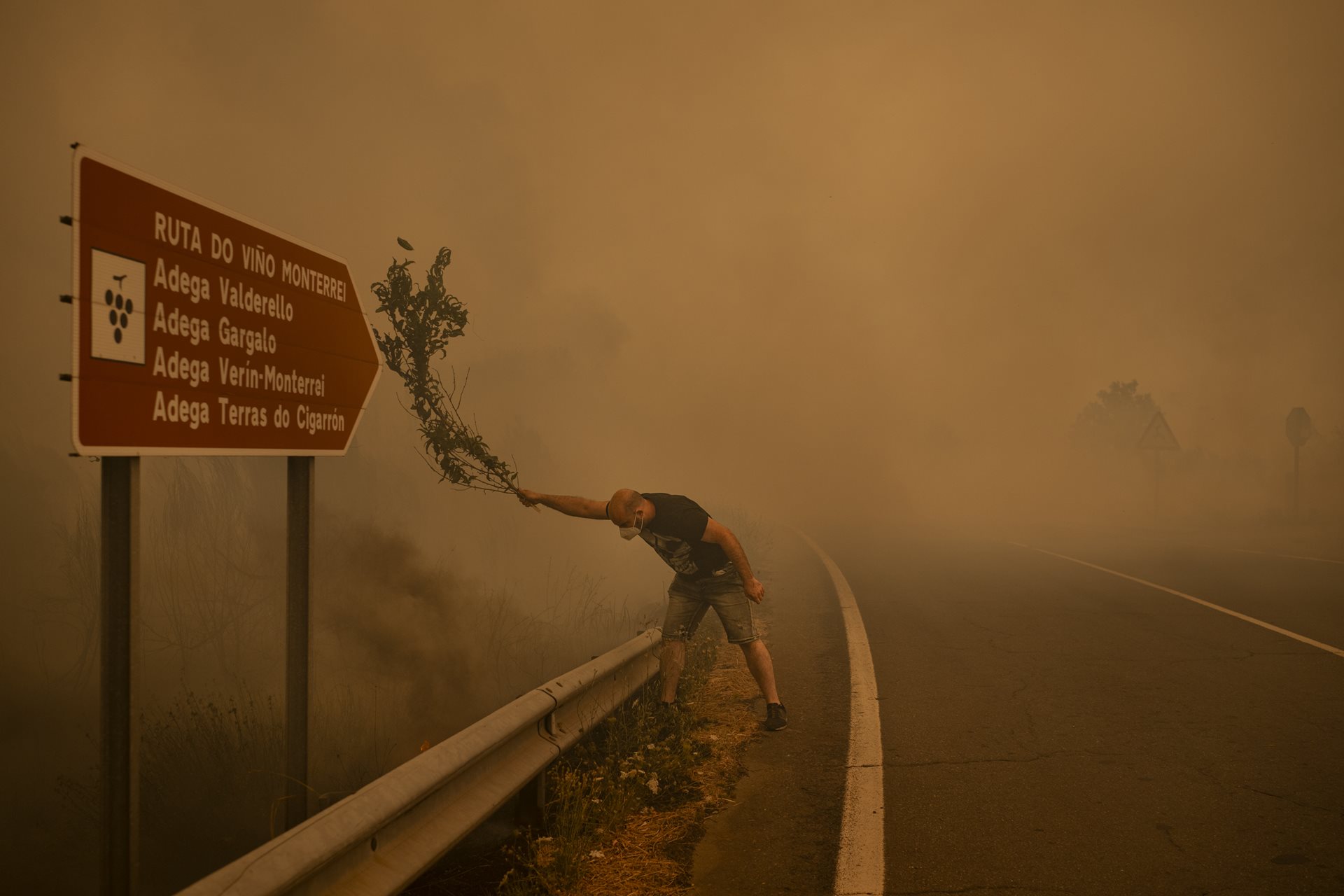


A man fights a wildfire with a branch in Cualedro, Ourense, Galicia, Spain. When resources are stretched, residents use whatever is available to extinguish flames, including branches, farming tools, and water hoses.
In 2025, wildfires burned through an estimated 390 million hectares worldwide. More than 200,000 hectares burned across Galicia during Spain’s worst fire season in about three decades. Together with neighboring northern Portugal, the region accounted for two thirds of the one million hectares affected across Europe.
The increasingly severe fires in Galicia are attributed to a combination of factors. Climate data suggest that the extreme weather conditions that intensified the 2025 fires in the Iberian Peninsula are now about 40 times more likely due to climate change. Decades of rural depopulation have seen abandoned farmland converted to forest, which now covers nearly 70% of the region. While around 650,000 hectares of Galicia's territory is communal land managed by local forest communities, 97% of forest land is owned by approximately 700,000 small private holdings, leaving much of it unmanaged. In addition, shortsighted planting policies favoring fast growing, non-native species for economic gain have created highly flammable landscapes.
In August 2025, Spain's Prime Minister Pedro Sánchez acknowledged that wildfire prevention had been “clearly insufficient” and pledged to do “whatever it takes” to prevent fires of such a scale again. In January 2026, the government approved new coordination measures for the prevention, monitoring, and extinction of forest fires.
Born in Ourense, the photographer grew up with the smell of smoke every summer and has documented Galician wildfires since 2011.
In a time when independent photojournalism is increasingly vulnerable, donations from people like you give us the ability to work globally with photographers who believe in the power of photography to inspire change. Support World Press Photo today.