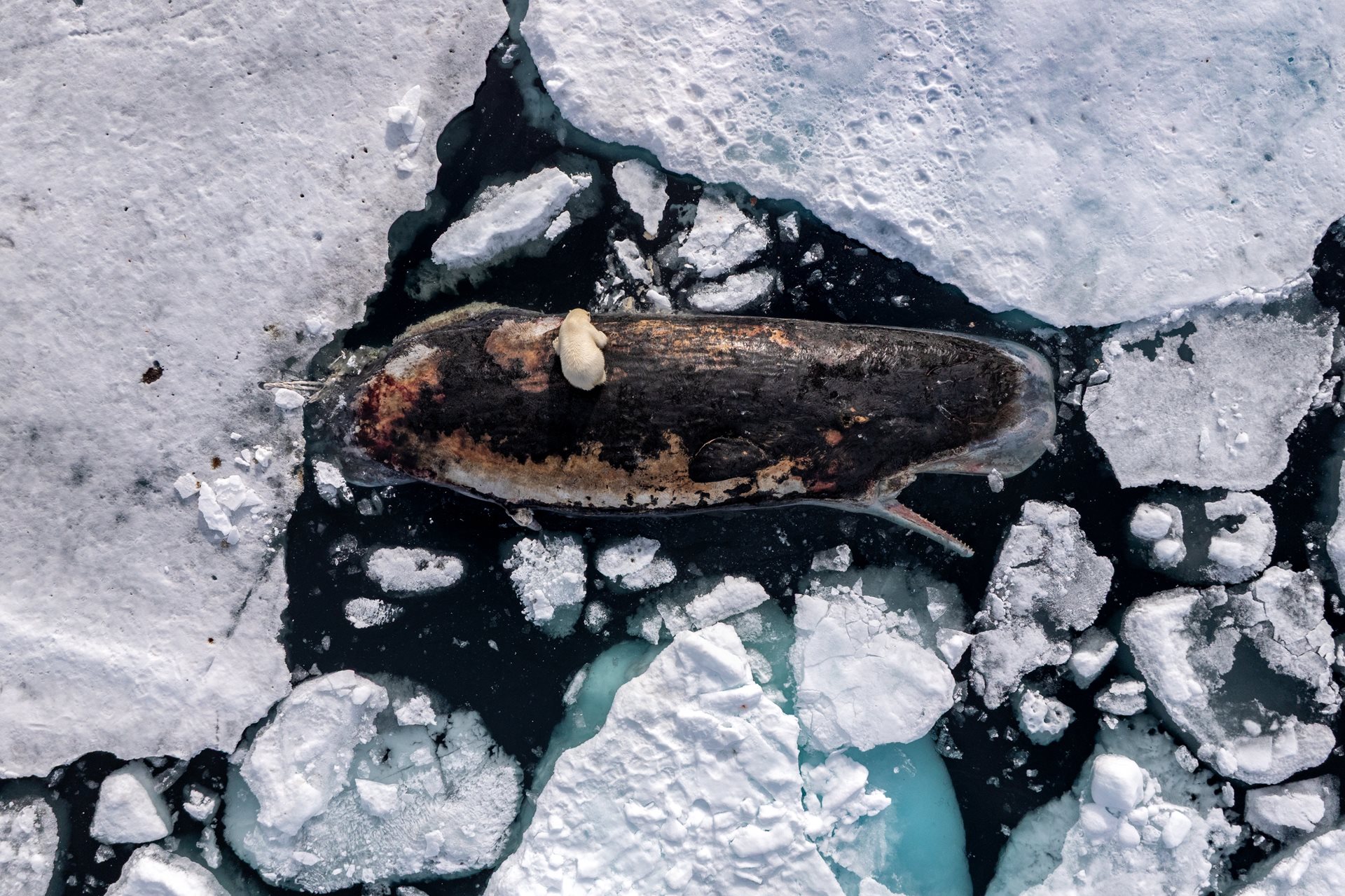


A female polar bear feeds on a sperm whale carcass in the polar pack ice north of the Norwegian archipelago, Svalbard. 82° North, International Waters.
The Arctic is warming almost three times as fast as the rest of the world; near Svalbard, the ice-free summer season has lengthened by 20 weeks in the last 30 years. Polar bears are primarily seal predators and rely on sea ice as a platform for hunting, breeding, and travel. As ice breaks up and open water expands, bears must cover greater distances and swim for longer, expending more energy while catching less prey. Polar bears in Svalbard are increasingly reliant on opportunistic scavenging and consume more land-based prey, including reindeer and walruses. However, scientists widely agree that continued ice loss will ultimately result in population declines.
Sperm whales typically avoid ice-covered polar waters, so this carcass was a rare sight. As deep feeders, they dive between 300 and up to 2000 meters in search of prey, favoring open ocean trenches over shallow Arctic seas. Scientists speculate that after dying, the male sperm whale drifted north, carried by winds and currents. Most whales that die at sea sink, but roughly 10% become buoyant as a result of gas production during decomposition.
The photographer spent two days observing the scene from a small boat, capturing it by drone to reveal a scale difficult to grasp from sea level. At around 350 kilograms, the polar bear is dwarfed by a sperm whale weighing more than 40 tons.
At no time is the need for accurate information more essential, while at the same time, more difficult to produce. That’s why we all need to support a free press. Make a donation to World Press Photo today to strengthen photojournalism.