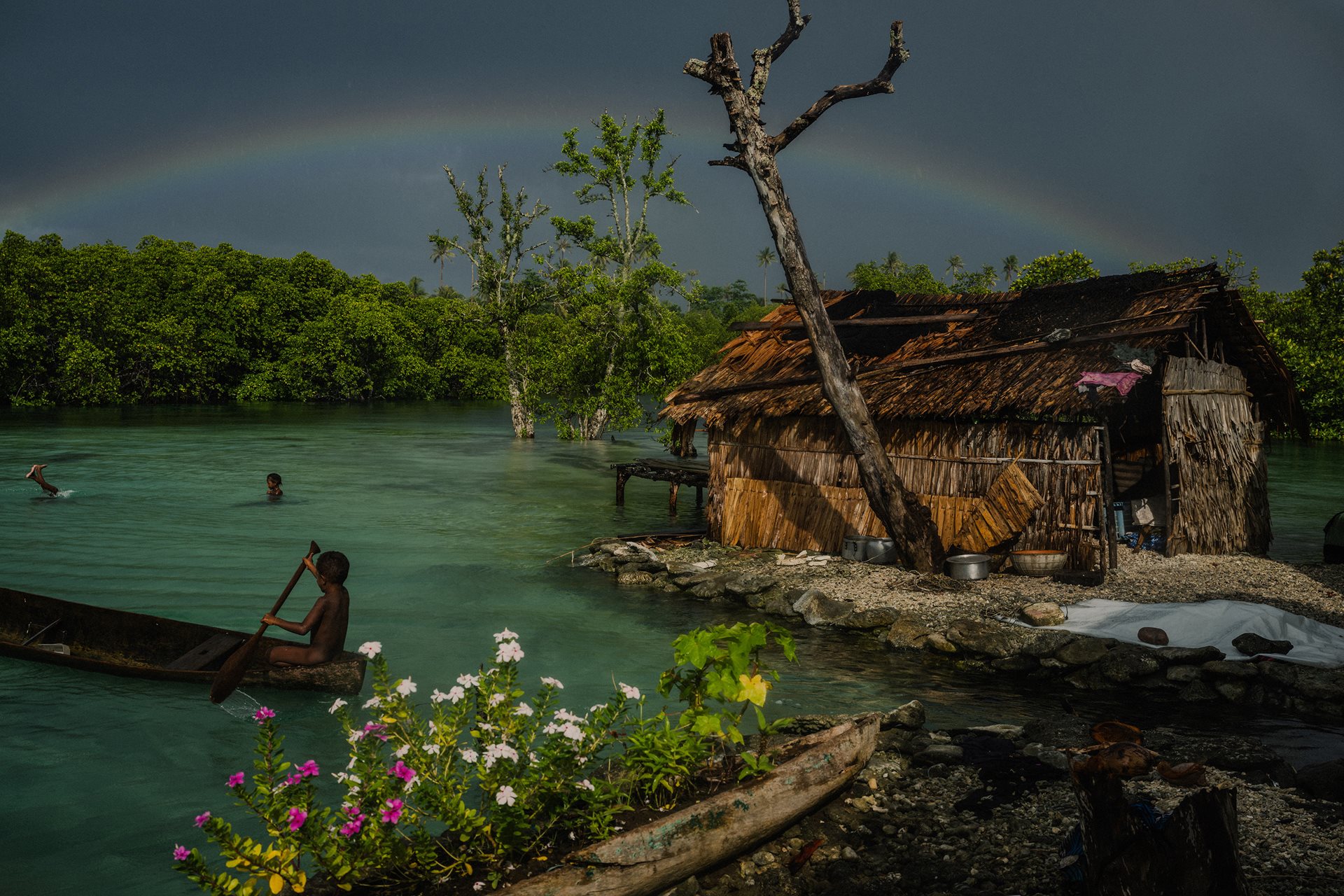


After a severe storm, children play in canoes among houses surrounded by the encroaching ocean. For the younger generation, daily life is defined by the constant threat of the disappearance of their land. Fanalei Village, Fanalei Island, South Malaita, Solomon Islands.
The people of Fanalei, a small settlement in the Solomon Islands, are adapting to a life lived on the edge of an encroaching sea: graves have been moved, a church has been washed away, and sea walls are built and rebuilt. For generations, the community has hunted dolphins, a deeply traditional practice that provides both food and dolphin teeth. These teeth function as a unique form of currency used in bride-price ceremonies and as a local tender to fund schools, churches, and the purchase of property on the mainland.
However, dolphin hunting is a grueling and uncertain collective effort. Since 2024, the introduction of seaweed farming has offered a relatively lucrative and stable alternative to dolphin hunting. Dried seaweed, destined for global pharmaceutical and cosmetic supply chains, now provides families with a dependable cash income, allowing families to buy basic goods without relying on traditional exchange.
As seaweed farming expands, fewer canoes are available for dolphin hunting, creating new tensions in the community. After years of international pressure to end dolphin hunting, many residents now point to seaweed farming as the economic force that may finally put an end to the controversial practice. This project captures a community at a complex crossroads, confronting the loss of its island, continued reliance on a contested tradition for survival, and a social order being reshaped by new economic forces.
For World Press Photo, public accessibility is vital, and an important principle in documentary photography, however, this must be accompanied by care. To document this story, the photographer spent an extended period on the island of Fanalei, building connections with the island's chief, residents, and their families, and observing their daily way of life. While this image does include nudity, it has been published after careful consideration and in consultation with industry experts and the community. In all cases, consent for contest winning images and subsequent publication has been appropriately handled.
World Press Photo welcomes any feedback by emailing contest@worldpressphoto.org