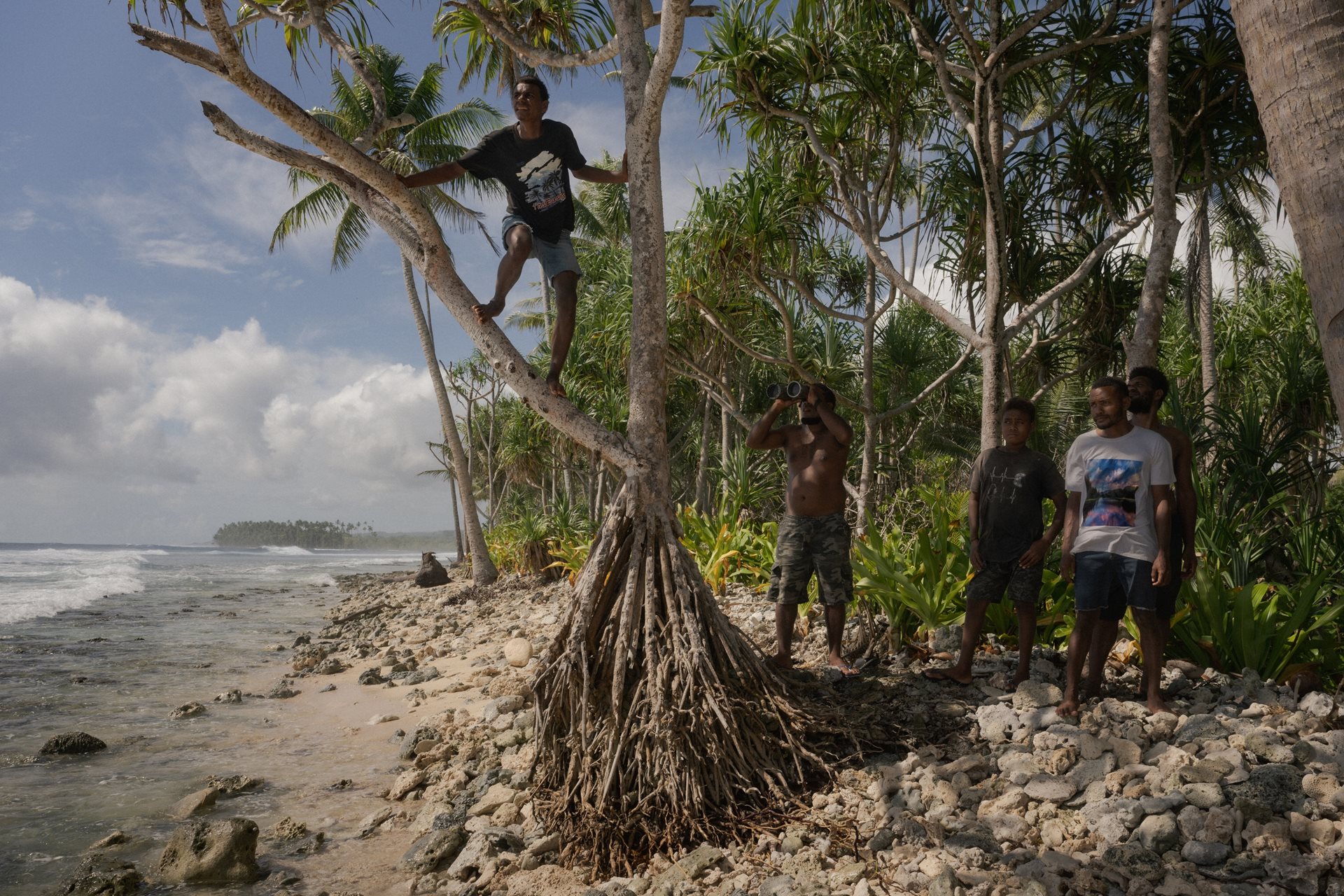


Young men scan the Surodo Lagoon for signs of a successful hunt. During the 2025 season, unpredictable weather and rougher seas resulted in repeated failed attempts for the Fanalei dolphin hunters. Fanalei Island, South Malaita, Solomon Islands.
The people of Fanalei, a small settlement in the Solomon Islands, are adapting to a life lived on the edge of an encroaching sea: graves have been moved, a church has been washed away, and sea walls are built and rebuilt. For generations, the community has hunted dolphins, a deeply traditional practice that provides both food and dolphin teeth. These teeth function as a unique form of currency used in bride-price ceremonies and as a local tender to fund schools, churches, and the purchase of property on the mainland.
However, dolphin hunting is a grueling and uncertain collective effort. Since 2024, the introduction of seaweed farming has offered a relatively lucrative and stable alternative to dolphin hunting. Dried seaweed, destined for global pharmaceutical and cosmetic supply chains, now provides families with a dependable cash income, allowing families to buy basic goods without relying on traditional exchange.
As seaweed farming expands, fewer canoes are available for dolphin hunting, creating new tensions in the community. After years of international pressure to end dolphin hunting, many residents now point to seaweed farming as the economic force that may finally put an end to the controversial practice. This project captures a community at a complex crossroads, confronting the loss of its island, continued reliance on a contested tradition for survival, and a social order being reshaped by new economic forces.
At no time is the need for accurate information more essential, while at the same time, more difficult to produce. That’s why we all need to support a free press. Make a donation to World Press Photo today to strengthen photojournalism.