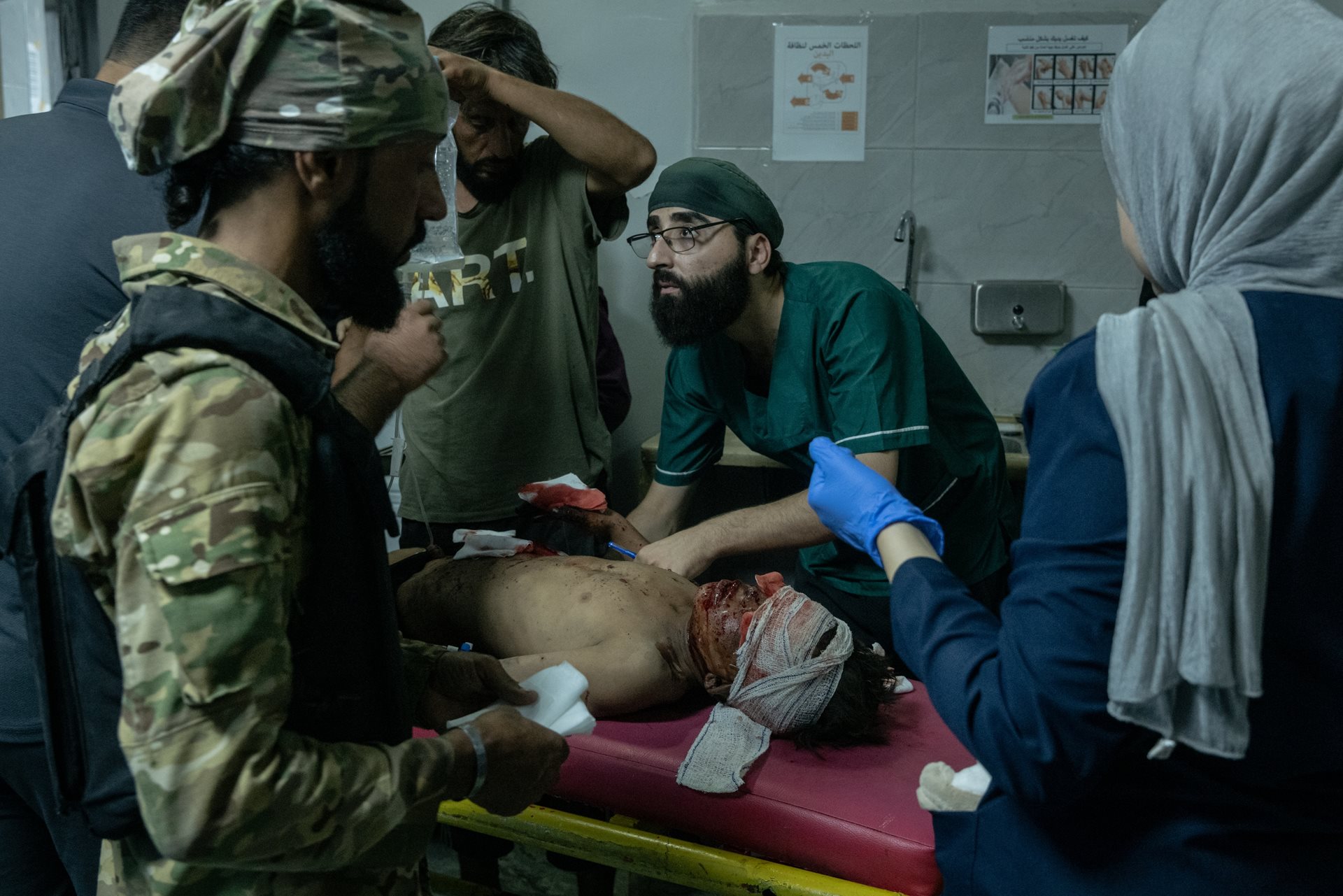


Fadi (13) receives treatment for his injuries at the National Hospital in Deir al-Zour, Syria. The boy was injured and his mother was killed as they scavenged for scrap plastic at a dump site, accidentally detonating an unexploded device.
Long neglected by the Syrian state and one of the first cities to rise up in the 2011 revolution, Deir al-Zour endured years of siege, bombardment, and successive occupation by government forces, ISIS, and Kurdish-led fighters.
Demonstrations against the regime of Bashar al-Assad began in Deir al-Zour in March 2011, and were met with arrests and shootings by the Syrian government. By 2012, the Free Syrian Army had gained control of large parts of the city, though government forces retained key positions including the military airport, leaving the city divided. In 2014, ISIS swept across eastern Syria, capturing most of the Deir al-Zour province. In 2017, Syrian government forces broke the siege with the support of Iranian-backed militias and Russian airpower, recapturing the western bank of the Euphrates River, while the eastern bank fell to the Kurdish-led Syrian Democratic Forces (SDF) with US support.
The conflict left around 75% of the city’s infrastructure damaged or in ruins. Seventeen neighbourhoods were almost completely destroyed. Aid agencies have helped returning residents repair homes, restore irrigation systems, and reopen schools, but rebuilding remains slow due to the scale of destruction, limited funding, and the ongoing threat of unexploded ordnance (explosive weapons that failed to detonate after being deployed). The province of Deir al-Zour accounts for roughly a quarter of all incidents involving unexploded ordnance across Syria, affecting residential areas, farmland, roads, and infrastructure. The city's recovery has been further hindered by its political division: after the fall of the Assad regime in December 2024, the Euphrates River marked a divide between the new Syrian transitional government and SDF control, complicating daily movement, trade, and access to services for residents.
Following a ceasefire agreement in January 2026, the transitional government established control over most of the region, with SDF forces largely withdrawing or integrating into the new government structure. That same month, a UN Development Programme project was launched to clear 75,000 tons of rubble from the region.
Behind every powerful image is a story someone chose to tell. And often, a risk someone chose to take. Support World Press Photo by making a donation to ensure these important stories are seen across the globe.