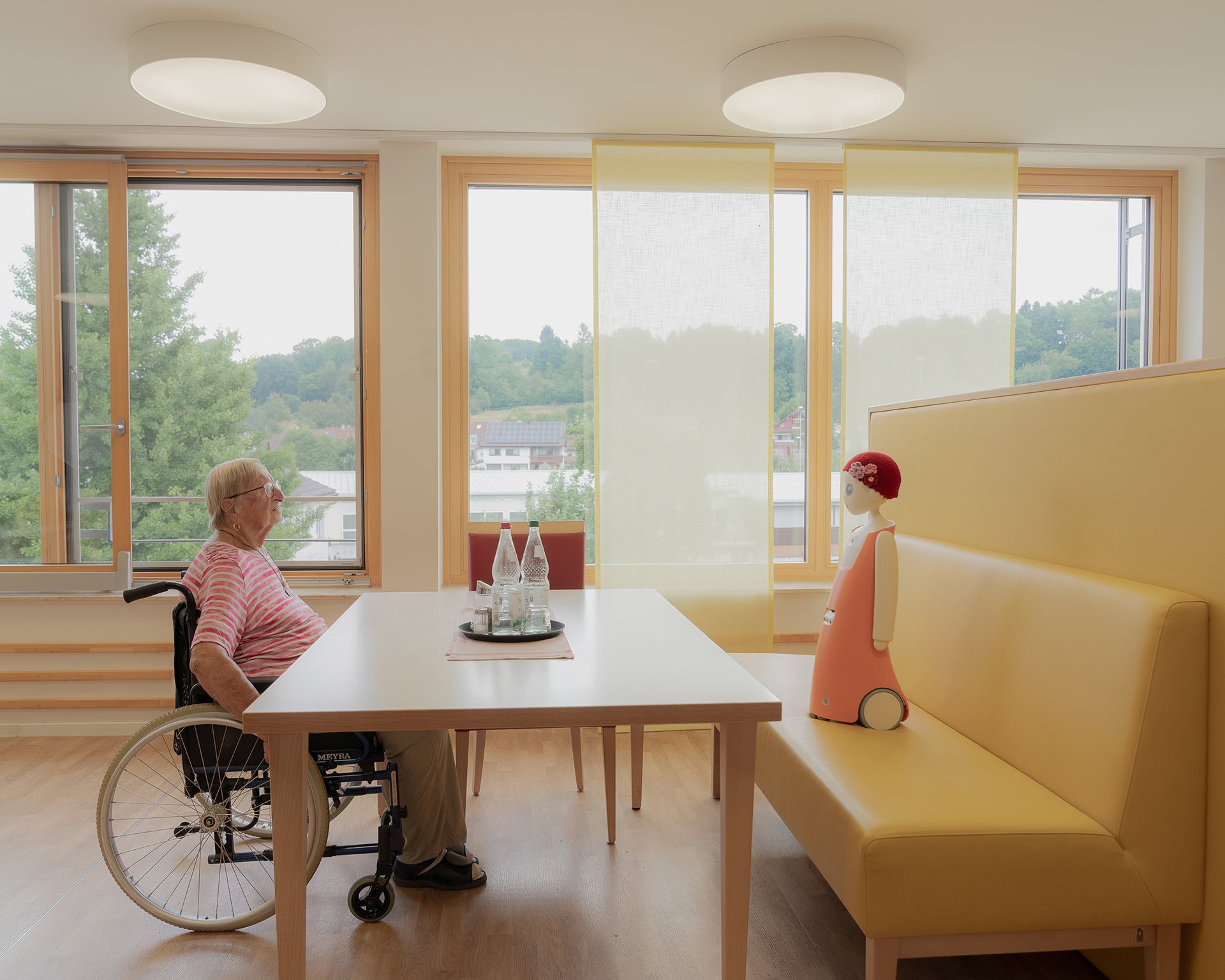


Waltraud talks with Emma, a social robot that recognizes faces and remembers past conversations. Though skeptical at first, Waltraud says she felt connected to Emma over time. Albershausen, Germany.
Germany’s care homes are facing two crises: staff shortages and loneliness. By 2035, one in four people in Germany will be aged 67 or older, putting facilities under increasing pressure. Loneliness among the elderly is a growing global concern; research shows that 20 to 40% of older people report moderate to severe loneliness, a figure that is steadily rising. In Germany, a 2023 study found that one in five care home residents aged 80 and older describe themselves as “severely lonely.”
This reality has prompted trials of social robots like Emma, developed by a Munich-based startup. Designed to engage residents through conversation, it recognizes faces, recalls previous exchanges, analyzes nonverbal cues, and responds with both speech and gesture. A year-long study at Haus im Wiesengrund care home in Albershausen found that staff see potential for social robots to improve residents’ quality of life, though there are limitations. Emma cannot move independently, and conversations are not yet always fully coherent. As one employee noted, it remains “a very expensive entertainment device” for now.
Waltraud, a resident of Haus im Wiesengrund, had her doubts but over time formed a bond with Emma. “When she tells her jokes, that’s really good. That’s my kind of humor,” says Waltraud, though she emphasizes that human contact is always preferable.
As robots and artificial intelligence expand beyond the workplace into wider society, questions arise about autonomy, privacy, and the limits of technology. For the photographer, whose mother works in a hospital using robots, this project grew from personal interest into a nationwide investigation of how robots are reshaping work and daily life in Germany.
Behind every powerful image is a story someone chose to tell. And often, a risk someone chose to take. Support World Press Photo by making a donation to ensure these important stories are seen across the globe.