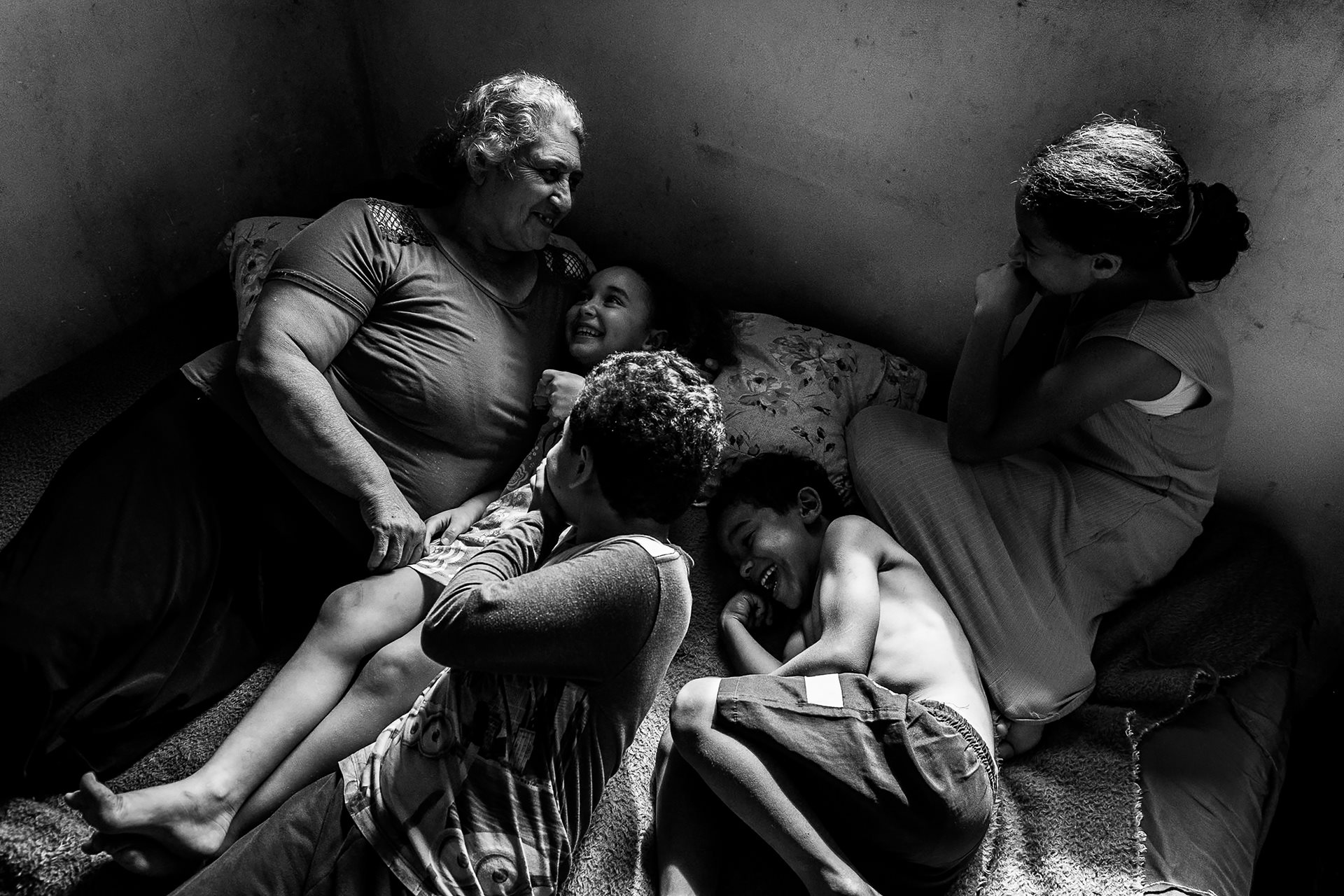


Sandra Mara Siqueira rests with her grandchildren: Ana Flávia (12), Davi Lucas (10), Micael (8) And Vitória (7), in Colombo, Paraná, Brazil. Sandra’s family seeks land regularization to secure legal ownership of their home, which would finally allow them to invest in permanent improvements and guarantee access to basic rights like water and electricity.
Brazil is currently facing a structural housing crisis, with a national deficit of approximately 5.9 million housing units. This shortage has pushed over 16.4 million people into informal settlements. In the city of Colombo, part of the metropolitan region of Curitiba, the Parque dos Lagos occupation serves as a microcosm of this struggle. Since 2013, approximately 200 families have occupied an abandoned plot of municipal land to demand their constitutional right to housing. Without legal tenure, these families live in improvised homes built from reclaimed materials, lacking official access to paved roads, sewage systems, or stable utilities.
For the residents of Parque dos Lagos, “land regularization” is the ultimate goal. This legal process would transform the occupation into an officially recognized neighborhood, granting residents formal ownership of their homes. Beyond providing security against eviction, regularization is the essential gateway to public infrastructure and the social dignity of citizenship. In late 2025, a significant step forward was taken when the Movimento dos Trabalhadores Sem-Teto (MTST) secured a partnership with the Ministry of Cities to temporarily suspend a long-standing legal dispute over the land, halt potential evictions, and open a window for negotiation between the community and the municipal government.
This photograph captures the intimate, daily reality of this fight for housing and recognition, documenting a space that is not defined solely by deprivation, but by collective organization and hope. Sandra Mara Siqueira serves as the primary anchor for the household, raising her grandchildren while providing community childcare for her neighbors. For Sandra, the fight for regularization is not merely a legal hurdle, but a multi-generational struggle for dignity.
At no time is the need for accurate information more essential, while at the same time, more difficult to produce. That’s why we all need to support a free press. Make a donation to World Press Photo today to strengthen photojournalism.