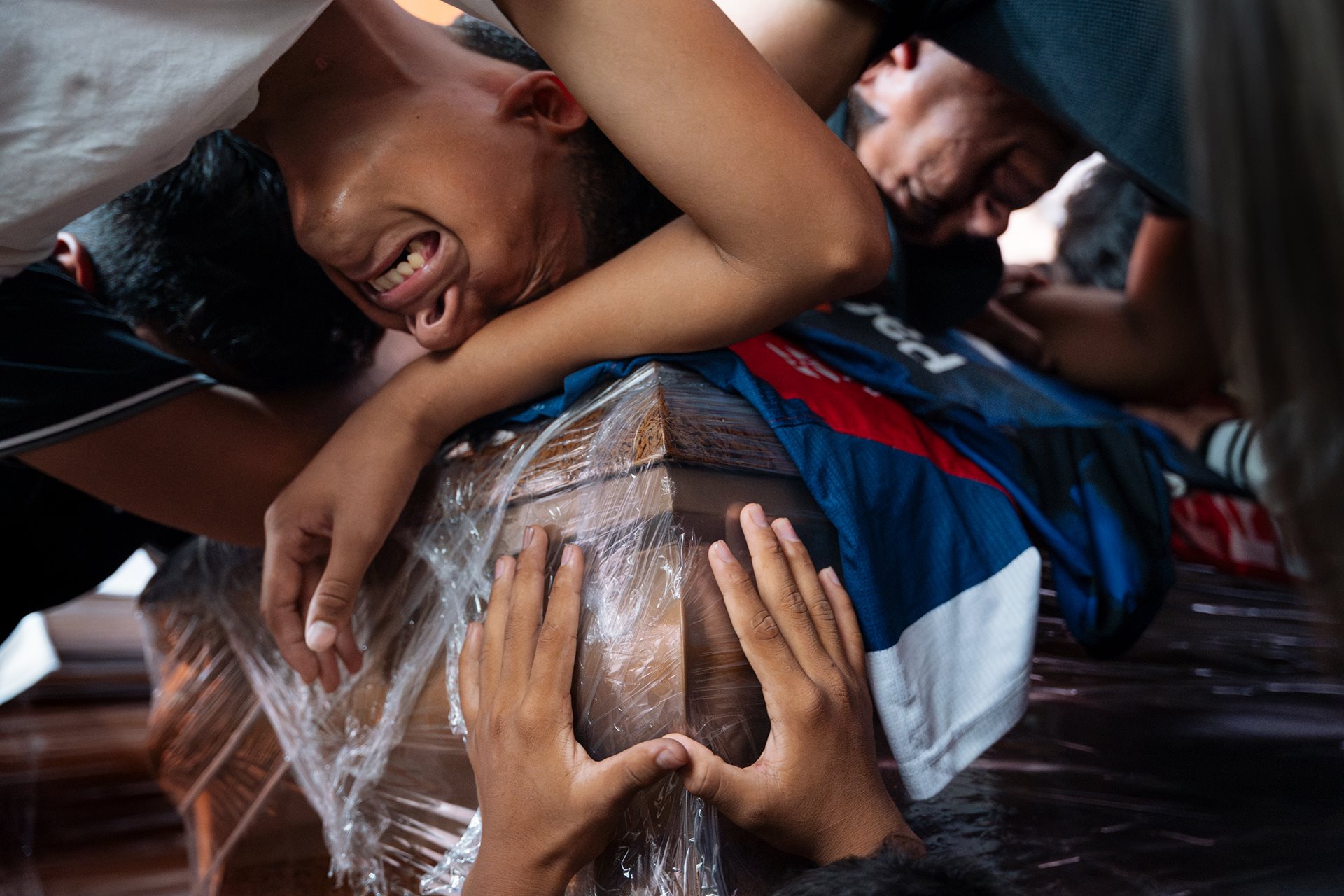


Teammates and a coach mourn over the plastic-wrapped coffin of 15-year-old Ismael Arroyo in the Las Malvinas neighborhood in Guayaquil, Ecuador. Ismael and three other boys were detained by military personnel on 8 December 2024; their burned remains were found two weeks later near an air base. The case has sparked nationwide outrage over racial profiling and military abuses.
In 2024, Ecuador’s President Daniel Noboa declared war on transnational criminal organizations, which were largely responsible for driving Ecuador’s homicide rate from one of the lowest in Latin America to one of the highest in the world. To combat Ecuador’s growing organized criminal violence crisis, the government deployed the military to marginalized neighborhoods and penitentiaries under a series of emergency decrees. While the administration claimed a significant reduction in violence, the “mano dura” (iron fist) approach has drawn condemnation from international bodies like the UN for systematic human rights violations. In cities like Guayaquil, these policies have frequently resulted in the racial profiling of Afro-Ecuadorian communities, where the line between criminal enforcement and state-sponsored violence has become blurred.
On 8 December 2024, Steven Medina (11), Nehemías Arboleda (15), and brothers Josué Arroyo (14), and and Ismael Arroyo (15) were returning from a football match in the Las Malvinas neighbourhood of Guayaquil when they were detained by a patrol from the Ecuadorian Air Force. Despite initial government denials of military involvement and attempts to label the boys as gang-affiliated robbers, video evidence and subsequent confessions revealed the brutal truth. The four minors were taken to a rural area near the Taura Air Base, where they were tortured before being killed. Their charred and dismembered remains were discovered on Christmas Eve in a mangrove swamp. In a landmark ruling in late 2025, 16 military personnel were convicted for the forced disappearance of the children, with several receiving sentences of over 34 years.
This photograph captures the collective grief of a community that was supposed to be protected by the very forces that targeted its children. The case of “The Four of Malvinas” has since become a symbol of resistance against policing strategies that equate poverty and race with criminality. For the families of Las Malvinas, the state’s victory in its “war” has come at the cost of the lives of four children whose only crime was walking home from a game.
Behind every powerful image is a story someone chose to tell. And often, a risk someone chose to take. Support World Press Photo by making a donation to ensure these important stories are seen across the globe.