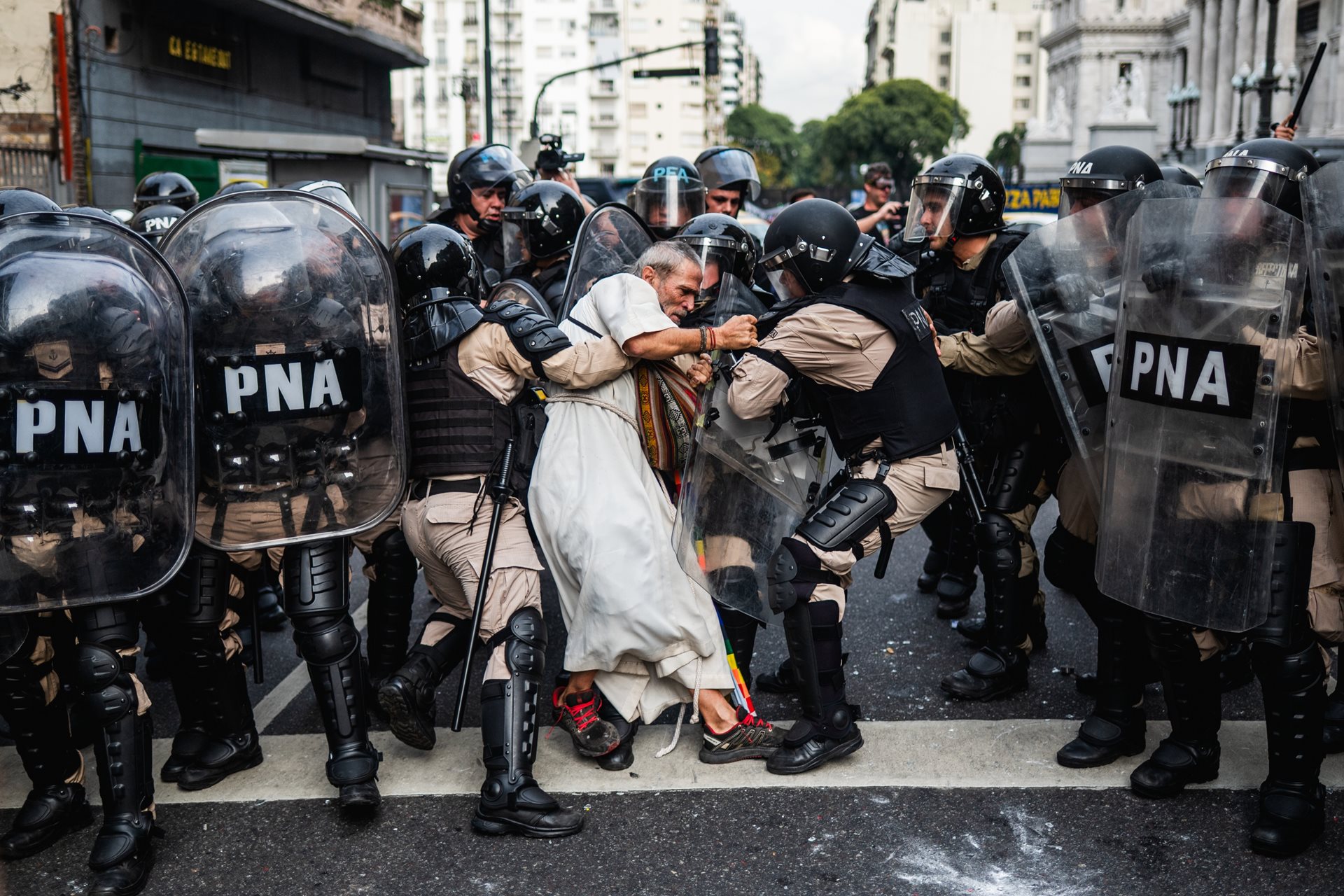


Police detain Father Jorge “Chueco” Romero during a pensioners’ protest in Buenos Aires, Argentina. Members of the “Opción por los Pobres” (Option for the Poor) clergy have joined weekly demonstrations against pension freezes and cuts to essential medical coverage. While Romero was thrown to the ground, he was later released.
Since taking office in 2023, Argentina’s President Javier Milei has implemented a series of aggressive austerity measures to stabilize an economy facing over 200% annual inflation. These policies, which included a 50% devaluation of the peso and the suspension of various public subsidies, have had a significant impact on the nation’s 7.4 million retired people. While the government achieved its first budget surplus in 12 years in 2025, one of the costs has been an accelerating decline in the real value of pensions.
The crisis is defined by a widening disparity between state support and the actual cost of living. By mid-2025, the minimum monthly pension reached a range of approximately $296 to $366 USD, while state officials estimated the minimum cost of living for an older person at $867 USD. The financial desperation of Argentina’s pensioners is compounded by the suspension of free medication programs and subsidies for essential services, turning the daily lives of those who spent decades in the workforce into a struggle to meet basic needs.
This economic pressure has fueled weekly “Wednesday protests” outside the National Congress in Buenos Aires. These demonstrations are frequently met with a heavily militarized police response. The Inter-American Commission on Human Rights (IACHR) has expressed concern over repeated episodes of violence, such as a 12 March protest that left 46 people injured, including a journalist with a skull fracture and an 87-year-old pensioner with a head injury. Escalating violence has drawn condemnation from various social sectors, most notably the “Opción por los Pobres” (Option for the Poor) clergy. These priests take a political stance, placing themselves physically between the police and the elderly to protect the right to protest in the face of aggressive state actions.
In a time when independent photojournalism is increasingly vulnerable, donations from people like you give us the ability to work globally with photographers who believe in the power of photography to inspire change. Support World Press Photo today.