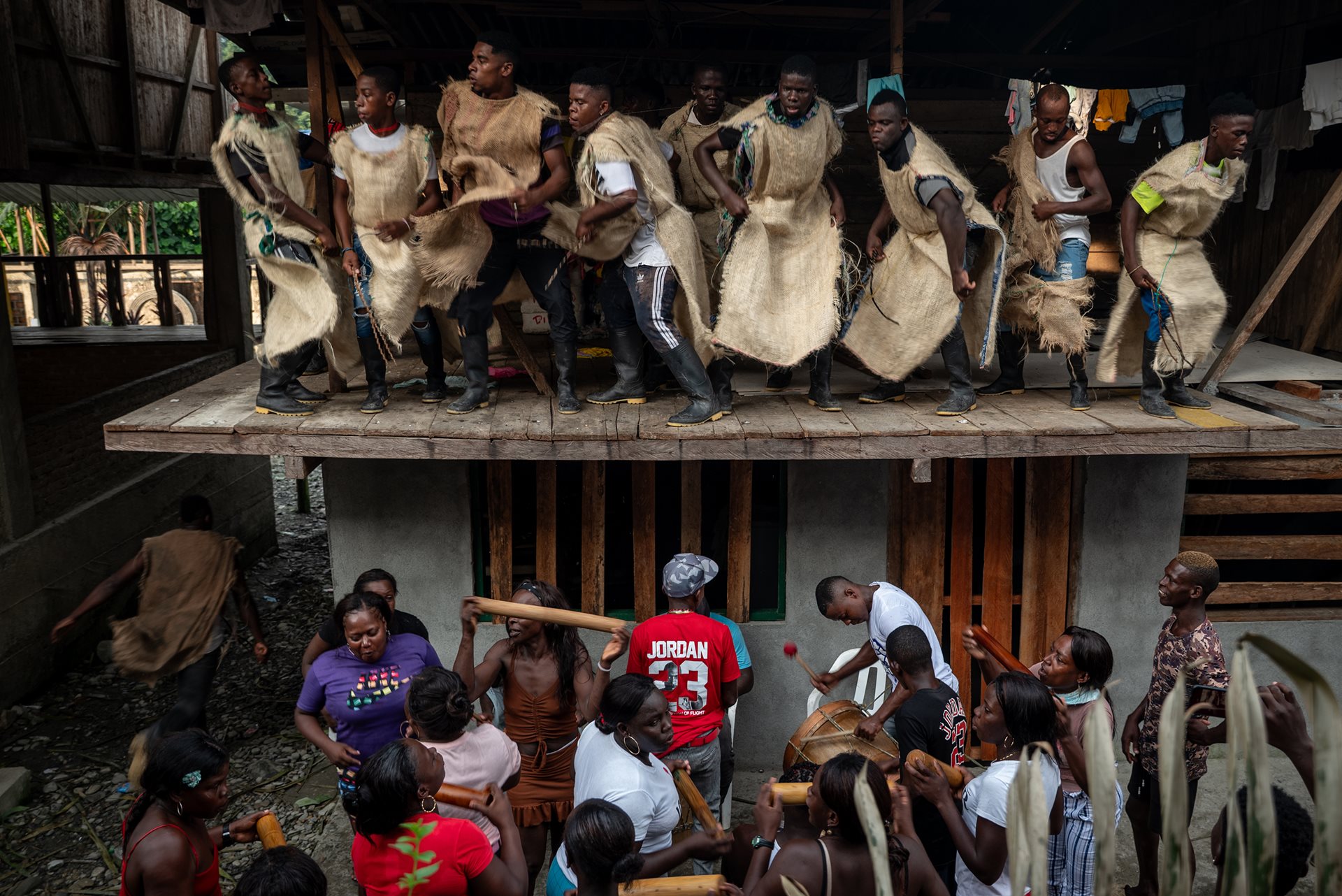


Jhony (sixth from left) leads the Manacillos through Juntas, Buenaventura, Colombia. The dancers visit every house to ask for protection and reconnect with the diaspora. For five days, displaced families return to the river to reaffirm their community bonds.
Deep within the Colombian Pacific rainforest, the community of Juntas is isolated yet under threat. Accessible only by a journey of eight to ten hours by boat from the city of Buenaventura, this Afro-descendant settlement was founded by Yurumanguireños, descendants of enslaved Africans brought to the region in the 17th century to mine for gold. Today, Juntas is part of a collective territory of 13 riverside settlements protected under Colombian law, yet it remains under constant threat from Illegal gold mining, industrial logging, and the presence of armed groups who vie for control of this strategic route.
The Fiesta de los Manacillos serves as the community’s most potent act of cultural expression. Enacted annually during Holy Week, this traditional ritual involves a performance by the Manacillos, men dressed in costumes of burlap sacks and banana leaves, wearing colorful masks carved from balsa wood. The festival is a fusion of religious beliefs and practices that combines Christian rituals with Afro-descendant spiritual expressions. The Manacillos perform a complex and layered ritual: they are the spirits of the soldiers who judged Jesus, but their game of whipping also mockingly reenacts the violence of the enslavers who once dominated this territory. For the hundreds of residents displaced to cities like Buenaventura or Cali, the Fiesta de los Manacillos is a homecoming, swelling the village population from 800 to an estimated 1,500 participants.
This project captures the Fiesta de los Manacillos not as a mere folklore performance, but as a political and social affirmation of a community. In a region where the state is often absent, these rituals provide the social cohesion necessary to keep illicit industries and political violence at bay. The photographs present a community that refuses to be erased, using collective memory and spiritual tradition to sustain the Yurumanguí motto: “The territory is life, and life is not for sale.”
At no time is the need for accurate information more essential, while at the same time, more difficult to produce. That’s why we all need to support a free press. Make a donation to World Press Photo today to strengthen photojournalism.