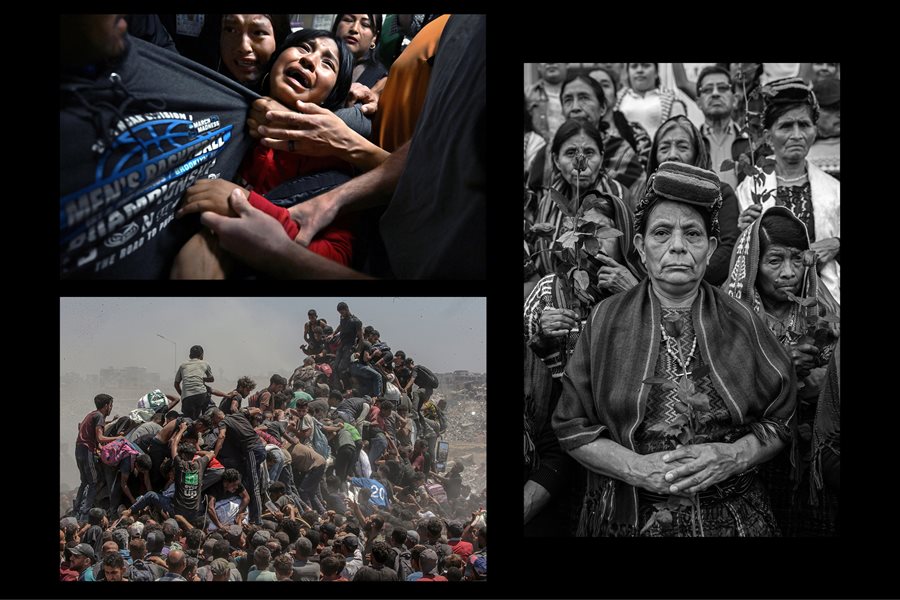
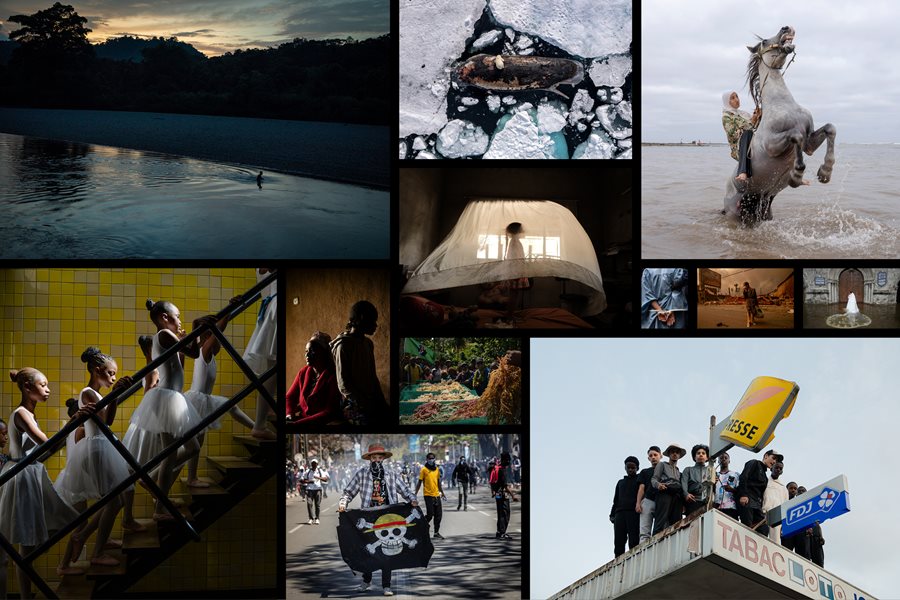
A photograph of a family forcibly separated in a courthouse by ICE in the United States, Palestinians facing famine in Gaza, and survivors of sexual violence granted justice in Guatemala, have been awarded the Photo of the Year and two finalists of the 2026 World Press Photo Contest.
The World Press Photo of the Year was selected from the 42 winners of the 2026 Contest, chosen from more than 57,000 entries. Every photographer awarded in the 2026 Contest was eligible to win this award. The entries were judged first by six regional juries and all winners were chosen by a global jury consisting of the regional jury chairs plus the global jury chair.
“Photojournalism has never been easy work. It has never been lucrative, or safe, or guaranteed an audience. And yet photographers go. To the courthouses and the conflict zones, to the quiet corners of the world where history is being made without witnesses. They go because they believe that seeing matters. That evidence matters.” – Kira Pollack, global jury chair of the 2026 Contest
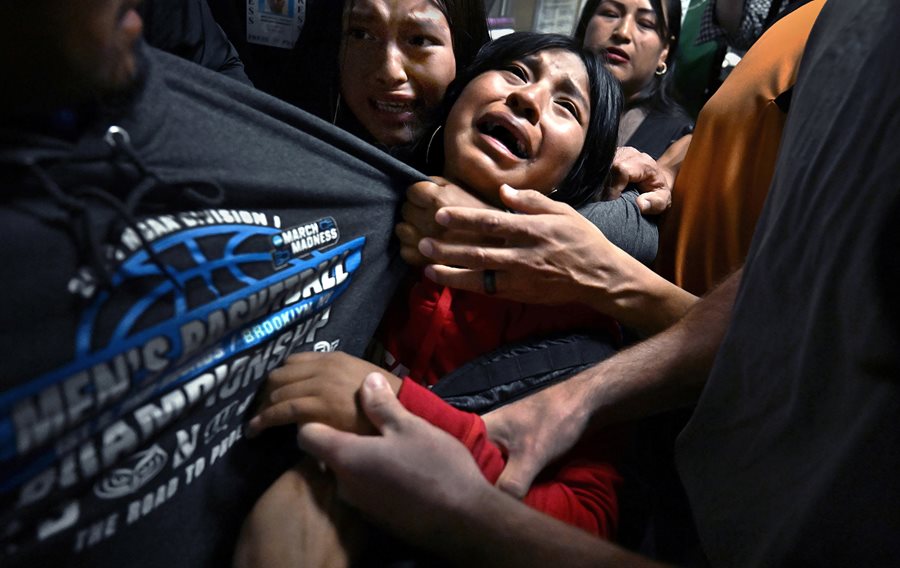
This photograph, taken inside one of the few US federal buildings where photographers were granted access, captures a harrowing moment: a family separated by the state. Luis, an Ecuadorian migrant, was detained by ICE agents following an immigration court hearing at the Jacob K. Javits Federal Building in New York City, New York, United States, on 26 August 2025. His family says he has no criminal record, and served as the household’s sole provider. Luis’ wife Cocha and their three children – ages seven, 13, and 15 – were left inconsolable, facing immediate financial hardship and profound emotional trauma.
The jury commented: “What Guzy records here is not an isolated moment of grief, rather, it is evidence and documentation of a government policy being applied systematically to people who followed the rules they were given. In a democracy, the camera's presence in that hallway is not incidental, it is essential.”
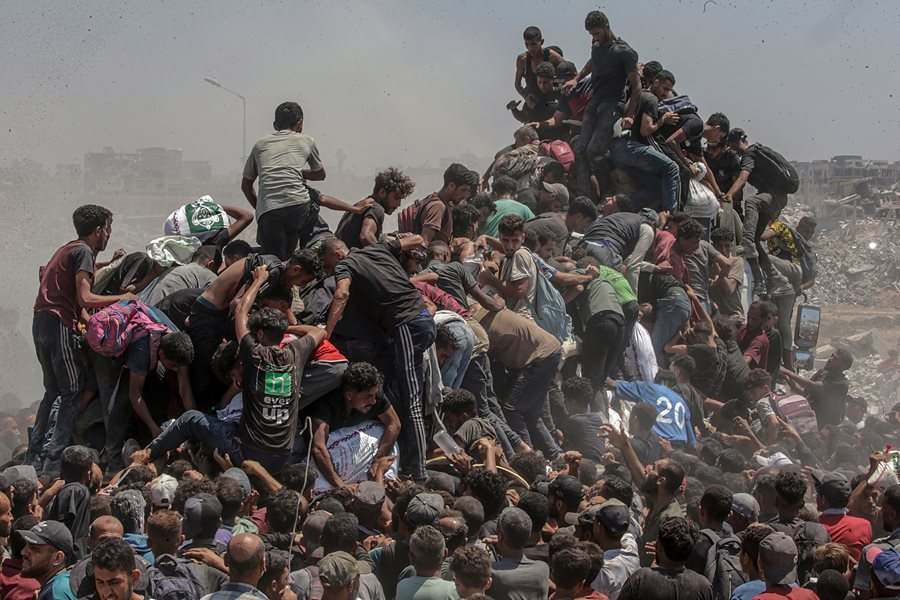
Palestinians climb onto an aid truck as it enters the Gaza Strip via the Zikim Crossing in an attempt to get flour, during what the Israeli military called a “tactical suspension” in operations to allow humanitarian aid through. 27 July 2025.
In 2025, famine took hold amid what an
independent United Nations Human Rights Commission inquiry has concluded is a genocide in Gaza, which Israel disputes. Israeli authorities imposed a complete aid blockade in March, a tactic described by humanitarian organizations as the weaponization of starvation. The
UN reports that between late May and early October, at least 2,435 Palestinians seeking food were killed at or near aid distribution sites. Despite a ceasefire agreement in October, more than 75% of the population still face hunger and malnutrition. The photographer was born in Gaza and has documented life there since 1997.
The jury commented: “The straightforward composition forces the viewer to pause, and offers visual evidence of famine, and the destruction surrounding the scene. The jury felt that the photograph confronts the viewer with the reality of the situation while also pointing to its collective impacts and global implications.”
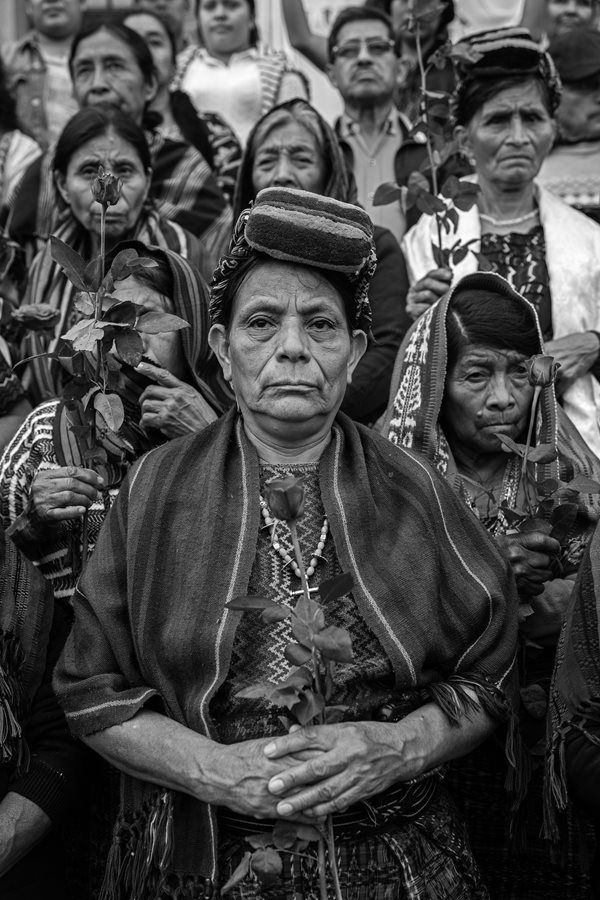
Doña Paulina Ixpatá Alvarado, a plaintiff who was held captive and assaulted for 25 days in 1983, stands with fellow Achi women outside a Guatemala City court in Guatemala, on 30 May 2025. That afternoon, three former civil defense patrollers were sentenced to 40 years in prison for rape and crimes against humanity.
For four decades, a group of Indigenous Maya Achi women in Rabinal lived in the same communities as the men who had raped them, sometimes as neighbors. Guatemala’s civil war led to the genocide of thousands of Maya Achi people by the military and local state-backed paramilitary forces, who used sexual violence as a systematic weapon to subjugate Indigenous communities. In 2011, 36 women broke their silence, launching and winning a 14-year legal battle against their abusers. Their collective resilience is transforming a legacy of wartime impunity into a historic victory for justice.
The jury commented that the photograph’s “classical, restrained approach emphasizes the women's dignity and authority, deliberately countering historical visual narratives that frame women—particularly survivors of sexual violence—as powerless subjects. Instead, the portrait documents a moment of collective strength at the conclusion of a fourteen-year-long struggle for justice.”
Read the full 2026 World Press Photo Contest jury report.
World Press Photo Exhibition 2026
These stories, alongside the other winners, will be shown to millions of people as part of our annual exhibition in over 60 cities around the world – including the flagship exhibition in
Amsterdam (opening 24 April), as well as Rome, Berlin, Vienna, Mexico City, Rio de Janeiro, Montreal, Jakarta, and Sydney. See our exhibitions calendar.
Meet the winners of the 2026 Contest