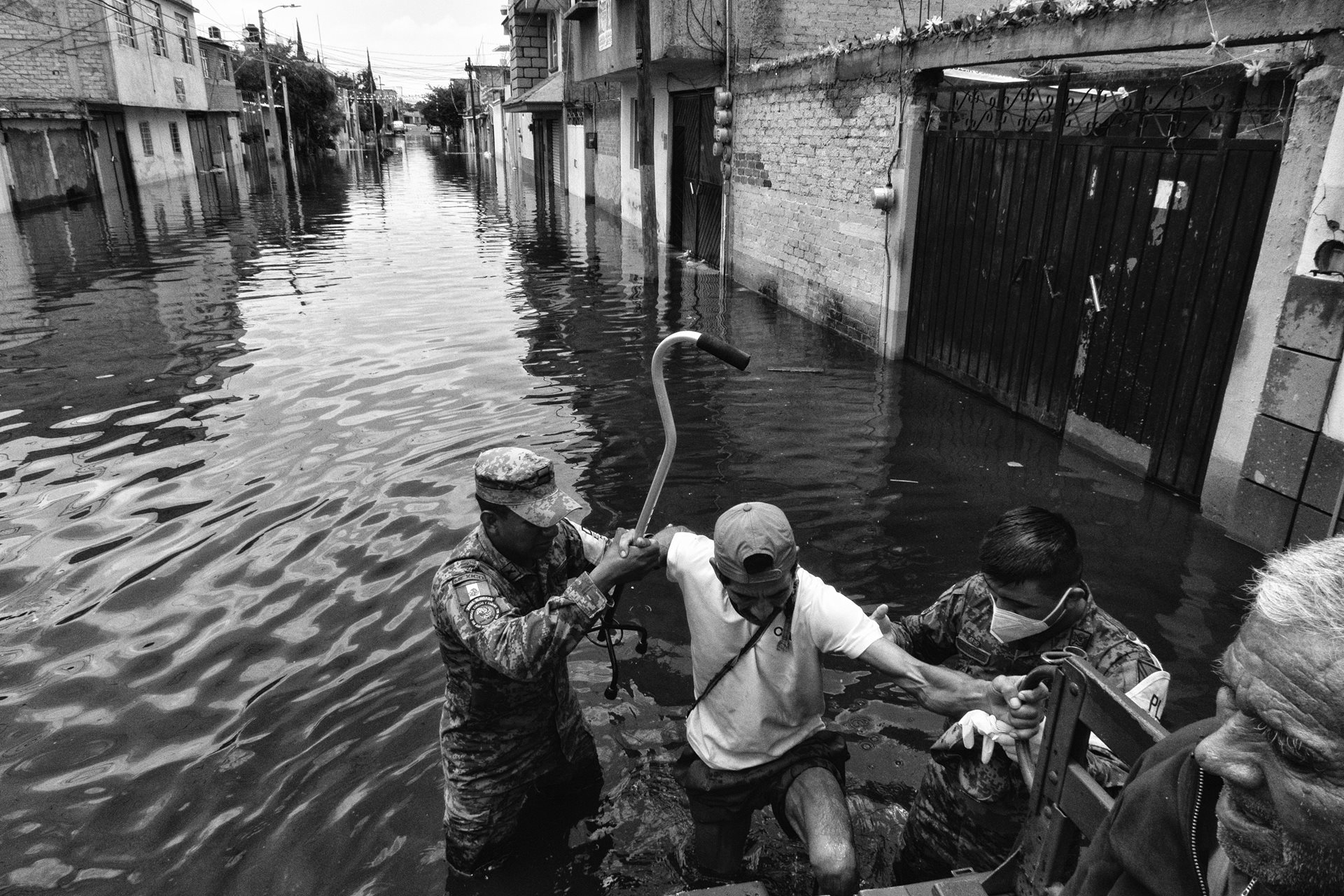


Flooding in Chalco, State of Mexico, Mexico, which has affected hundreds of families. Many have lost furniture, appliances, and irreplaceable personal belongings such as photographs and family keepsakes. Poor urban planning in former lake regions like Chalco has turned heavy rains into month-long disasters; residents describe the 2024 flooding as the worst in years.
Mexico is especially vulnerable to climate extremes, with 52% of its territory situated in arid or semi-arid zones. Over the last two decades, environmental disasters and ecological decay have internally displaced approximately 2.7 million people—a figure projected to reach up to 8 million by 2050. Rising seas swallow coastal towns while severe droughts drain the country’s water supply. Along the Gulf of Mexico, sea levels are rising three times faster than the global average, reclaiming entire communities like El Bosque in Tabasco, the first community in Mexico to be officially recognized as displaced by climate change. At the same time, in the industrial north and the central State of Mexico, renewable water availability has plummeted by 81% since 1950. In cities like Monterrey, the fluctuation between record-breaking heatwaves and catastrophic flooding has moved water from a public utility to a scarce commodity, often protected by police to prevent social unrest.
The photographer explores how these environmental shifts intersect with political choices and infrastructure failure. From the flooding in Chalco to droughts in Sonora, this Long-Term Project taken over four years captures a complex process by which customs, social dynamics, and collective memory in communities across Mexico are being transformed by increasingly severe environmental crises. Together, these images form a visual testimony of a country in transition, where climate change is not a future threat, but a force actively reshaping the present.
Will you join us to champion the power of photography to help people understand our shared world and inspire them to act? As a non-profit organization, we depend on support from people like you to be able to continue our activities. Make a donation.