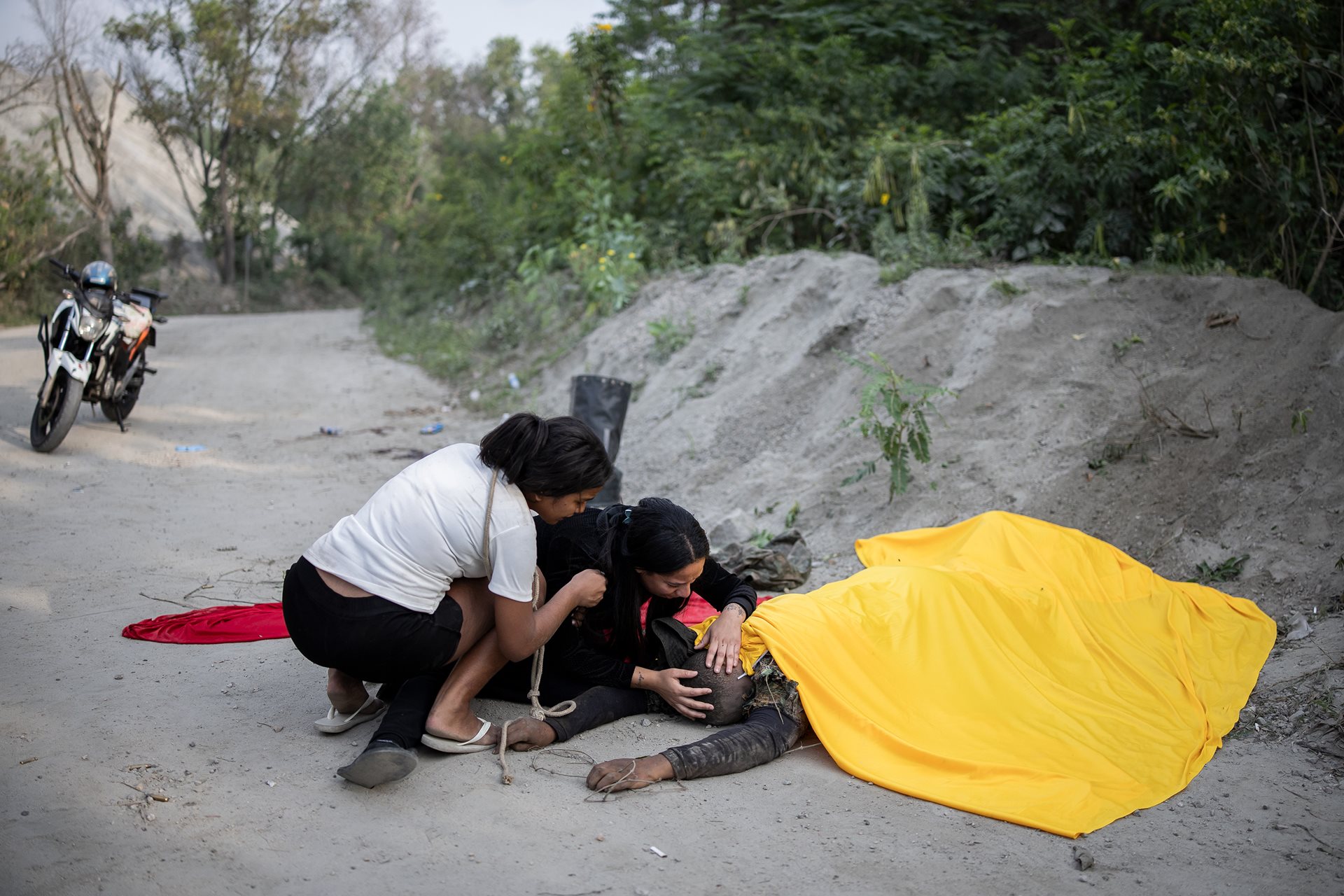


A woman breaks down after finding her husband among the deceased. The vast majority of the 122 casualties were Afro-Brazilians, reinforcing data that shows police violence in Rio de Janeiro disproportionately impacts the city's Afro-Brazilian population. Rio de Janeiro, Brazil.
On 28 October 2025, the favelas of Rio de Janeiro’s North Zone became the site of the deadliest police operation in Brazilian history. Known as “Operation Containment,” the raid deployed a record 2,500 civil and military officers into the Complexo do Alemão and Penha favelas, two areas home to approximately 110,000 residents and controlled by the Comando Vermelho (Red Command) criminal organization. While the state government justified the 17-hour mission as a necessary strike to execute 100 arrest warrants, the raid resulted in many casualties and few meaningful arrests. Official figures reported at least 122 dead, surpassing the 1992 Carandiru prison massacre as the nation’s most fatal security event.
The operation’s tactical success was widely questioned after it was revealed that none of the primary high-ranking targets were captured or killed. Instead, the violence disproportionately impacted Afro-Brazilians residents, who make up roughly 80% of the favela population. In the immediate aftermath, a total of 74 bodies were discovered in the Vacaria forest, an area between the two complexes where residents accused police of setting an ambush. Despite constitutional requirements and a 2025 resolution mandating immediate investigation into police killings, authorities failed to deploy forensic or rescue teams to the site, leaving the deceased to decompose in the forest.
The withdrawal of the state after the violent raids forced the community to bear the physical and emotional weight of carrying their own dead. Residents had to organize their own recovery efforts, using pickup trucks and improvised stretchers to carry their neighbors down to São Lucas Square. These acts of care and bereavement by the community are a symbol of the state’s relationship with the favelas: a presence defined not by protection or infrastructure, but by overwhelming force. A UN report claims that police in Brazil kill over 6,000 people annually — mostly of African descent. The report states that “These killings – often in operations targeting ‘criminals’ – are widespread and systematic, functioning as a form of social cleansing against marginalised groups.”
In a time when independent photojournalism is increasingly vulnerable, donations from people like you give us the ability to work globally with photographers who believe in the power of photography to inspire change. Support World Press Photo today.