The photograph does not ask for your permission.
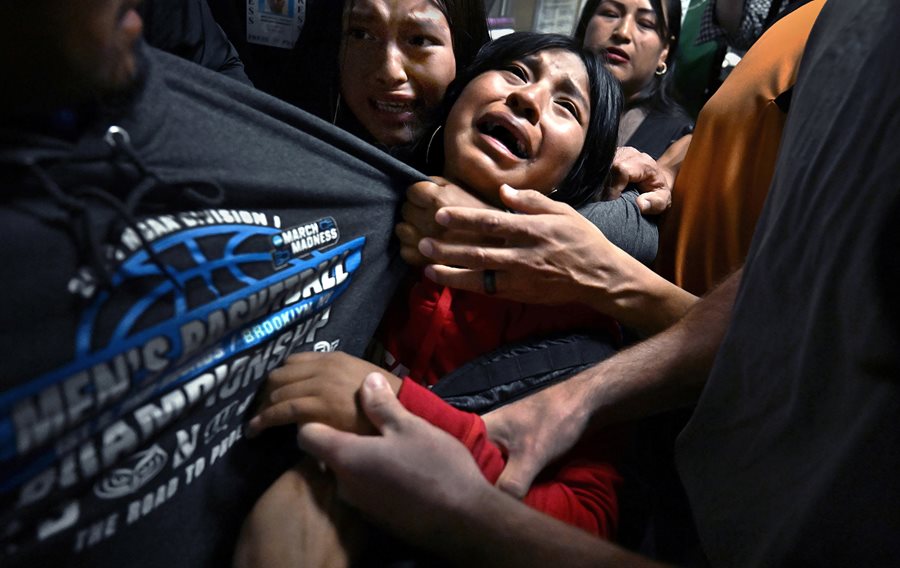
To the left of the frame is a father. His name is Luis. He is a migrant from Ecuador who arrived at the Jacob K. Javits Federal Building in New York City on 26 August 2025, for an immigration court hearing — following the rules he was told to follow. At the center of the image are his two daughters, 15 and 13. His wife Cocha is visible in the background. Outside the frame: their 7-year-old son. As Luis walked out of the courtroom, ICE agents pulled him away from his family.
Carol Guzy made this picture. It is the World Press Photo of the Year for the 2026 Contest. It is also part of a larger story by Guzy from that courthouse — recognized by the jury as one of the North and Central America Stories winners — a sustained narrative of what American justice looks like at this moment.
World Press Photo of the Year, Separated by ICE, Carol Guzy, ZUMA Press, iWitness, for Miami Herald
This photograph was made inside one of the only courthouses in the United States where photographers have been granted access — and then only to a single hallway — to do their work. What is documented here is not random misfortune. It is part of a pattern: an administration policy that separates families, applied systematically, at scale. Luis did what the law asked of him. He was detained anyway.
Many of the immigration roundups have taken place out of sight -- or without reporters present. But on this day at this courthouse, along this hallway, there was light. A small group of photographers has maintained a steady presence there for months — many without assignments or institutional support, committed to staying on the story regardless of what any single day yields.
What was recorded in this picture — the inconsolable grief of children losing their father in the hallway of a federal building built for justice — is evidence of a turning point in U.S. policy and its human cost.
I have spent my career believing in the power of photography to activate empathy — to make a viewer feel, even before they think, that something concerning is happening.
The most powerful photographs are layered and emotional. They collapse the distance between the person in the frame and the person holding the page. That is what the World Press Photo of the Year must do — and this image does it. It also did something else: it challenged us. This selection sparked debate within the jury. The question at the center of it was important: that images of Latina women in states of grief and desperation risk being exploitative. We took that seriously. But we also kept returning to what this picture is — an eyewitness document of a historic policy, enacted on a specific family, on a specific day, in a hallway built for justice. The photograph is not just emotional. It is a record. So too were the two finalist images for Photo of the Year, both of which stayed with us long after the deliberations ended.
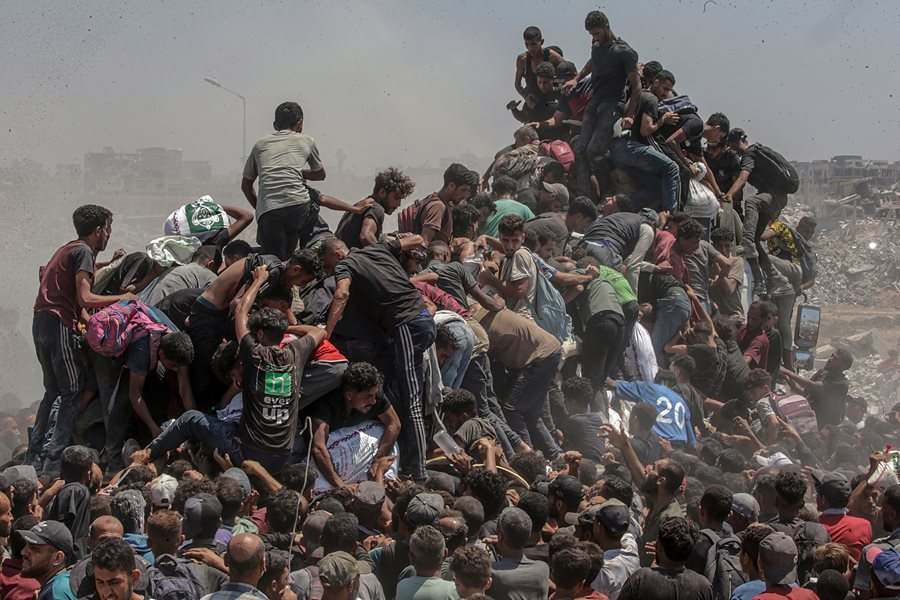
World Press Photo of the Year Finalist (above)
Saber Nuraldin, EPA Images
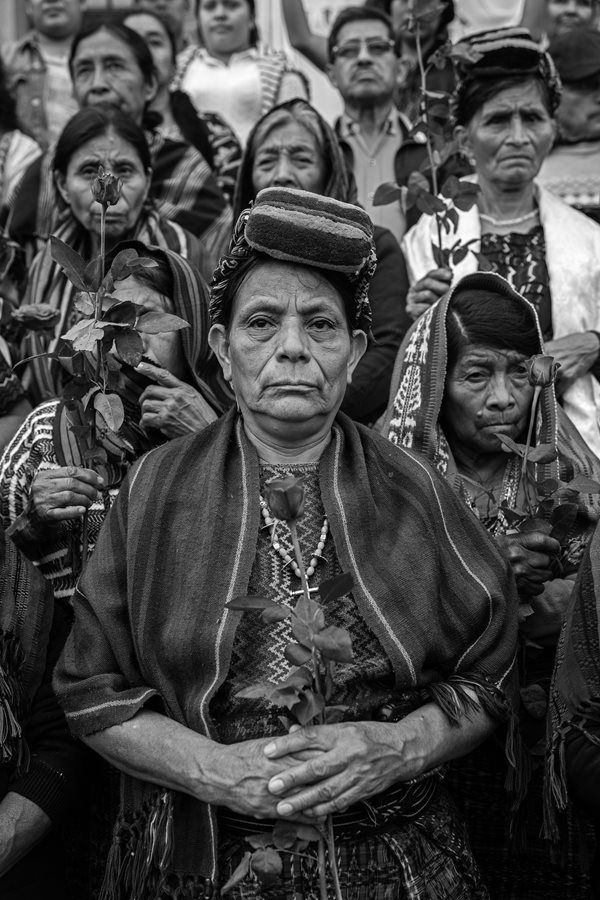
World Press Photo of the Year Finalist (left)
Victor J. Blue, for The New York Times Magazine
A photograph by Victor J. Blue of Doña Paulina Ixpata Alvarado — one of 36 Achí women who endured sexual violence as a weapon of war during the Guatemalan civil war and spent fourteen years pursuing justice — is dignified and restrained, and all the more powerful for it. She looks directly into the camera with dignity and authority, surrounded by fellow survivors. It is a portrait of collective strength at the conclusion of a struggle that remains far too common.
Together these three images — a family forcibly separated in a courthouse, survivors of sexual violence granted justice, a population forced to struggle for food— represent the breadth of what photojournalists bore witness to in 2025.
The photojournalists working today deserve recognition. What drives them is not money or fame. It is something closer to a calling: bearing witness, building a record, documenting communities whose experiences are often overlooked, insisting that evidence matters. Many do this without a safety net — freelancers who absorb the risk personally, who show up anyway, who find a way. Across wire services, international outlets, and newsrooms large and small, there are editors and publishers holding the line — investing in this work, refusing to let the visual record disappear. The infrastructure of photojournalism is under strain. It has not collapsed because people inside it are fighting to keep it standing.
What moved us as a jury was the extraordinary range and depth of what we witnessed.
Stories from every region, in every register: traditional photojournalism alongside lyrical work; sweeping documentary projects alongside intimate, years-long studies of a single community. Stories of rupture and loss, but also of resilience, dignity, and hope. What struck us most profoundly was the power of regional and local photographers documenting their own communities. There is something irreplaceable about a photographer who has spent years building trust within a community. Photojournalism is not only about breaking news. It is also about illuminating the quieter, more intimate dimensions of human experience — mental illness, displacement, the texture of suburban life, the private struggles that shape us as a society. World Press Photo's regional jury structure, with local leaders who brought deep knowledge to every selection, made space for exactly these stories. Work that would never have surfaced otherwise found its way to the final selection.
We were also unequivocal about the integrity of the images themselves. In an era of artificial intelligence and accelerating digital manipulation, World Press Photo's forensic verification process is uncompromising. We were strict about verification — every winner here has earned their place not only on the strength of their vision but on the foundation of their authenticity. In a world awash in synthetic imagery and disinformation, that standard is what makes this platform worthy of trust. World Press Photo reaches a global digital audience and travels the world through its exhibitions — bringing high-value, otherwise untold stories to people who would never have encountered them. That reach carries a responsibility. We took it seriously.
Photojournalism has never been easy work. It has never been lucrative, or safe, or guaranteed an audience. And yet photographers go. To the courthouses and the conflict zones, to the quiet corners of the world where history is being made without witnesses. They go because they believe that seeing matters. That evidence matters.
This is a critical moment — for democracy, for truth, for the question of what we as a society are willing to see and call out and what we are willing to ignore.
The photographers recognized here have done their part. They have made the record.
Now it is our turn to look.
In a time when independent photojournalism is increasingly vulnerable, donations from people like you give us the ability to work globally with photographers who believe in the power of photography to inspire change. Support World Press Photo today.